


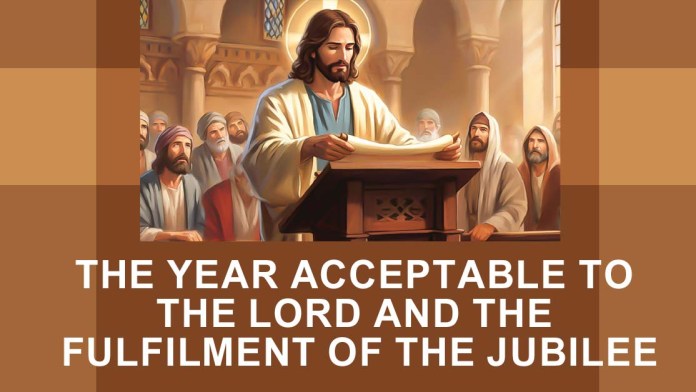
As the universal Church journeys through the Jubilee celebration with the blessed proclamation “Pilgrims of Hope,” it is appropriate to analyse, within this context, the relationship between the Old Testament observance of the Jubilee and the proclamation of the “year acceptable to the Lord” made by Jesus of Nazareth in the synagogue at Capernaum. Jesus’ powerful declaration in Luke 4:19, “to proclaim the year acceptable to the Lord,” is a clear statement that His ministry inaugurates the eschatological reality of the Jubilee Year foreshadowed in the Old Testament. The term Jubilee originates from the Hebrew word yōvĕl, meaning trumpet or ram’s horn (cf. Lev 25). In ancient Israel, the Jubilee was a socio-economic observance celebrated every fifty years. It aimed to prevent perpetual poverty, preserve tribal land ownership, cancel debts, restore ancestral property, and release Hebrew slaves. By quoting Isaiah 61:2, Jesus asserts that the ultimate fulfilment of these laws is realised in His own mission. He transforms the Jubilee from a temporary earthly observance into an eternal, spiritual, and universal reality of salvation.
This connection reveals the radical nature of Jesus’ ministry. The spiritual liberation He brings corresponds to the three dimensions of material freedom in the ancient Jubilee. The practice of cancelling debts is fulfilled in the forgiveness of sins-the spiritual debt humanity owes to God-which forms the core of “bringing good news to the poor” (Lk 4:18). The liberation of captives is accomplished through granting freedom to those who are bound and release to the oppressed, representing deliverance from the bondage of sin and from the powers of evil. The return to ancestral inheritance becomes spiritually real through reconciliation with God and the promised inheritance of the Kingdom of God. Hence, the “year of favour” is not simply a calendar year but an era of salvation and grace, a time in which the eternal and restorative fruits of the Jubilee are made available to all.
Most significantly, Jesus’ decision to stop reading before the phrase “and the day of vengeance of our God” (Is 61:2) highlights the nature of the fulfilled Jubilee. In His first coming, His focus is entirely on proclaiming favour-mercy and salvation. He inaugurates the age of this spiritual Jubilee. The judgement implicit in the prophecy is intentionally deferred. Thus, Luke 4:19 functions as a messianic proclamation announcing that the King is present, and that the ultimate and eternal Jubilee of restoration, remission, and liberation has arrived through His anointing and power. In Luke’s perspective, “the year acceptable to the Lord” becomes the theological centre of Jesus’ salvific mission.
Rev. Dr. Tom Olikkarott
