



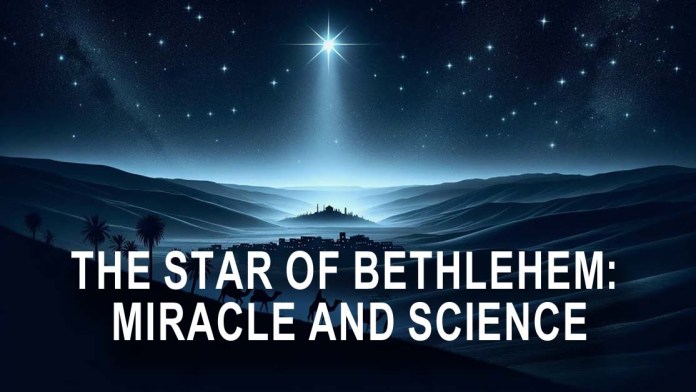
The “Star of Bethlehem” was an extraordinary phenomenon that appeared in the sky in connection with the birth of Jesus Christ. The Gospel of Matthew clearly describes this heavenly sign that guided the Magi to Jesus. The primary purpose of the star was to lead the Magi to Christ. These wise men from Persia—Balthazar, Gaspar, and Melchior—may have been familiar with Old Testament prophecies (Numbers 24:17). The Bible states that the star went before them until it came to rest over the place where the child was.
Scientific Theories and Their Limitations
For centuries, scientists and scholars have studied this mystery. Three major scientific explanations are commonly proposed:
*Planetary conjunction: The extraordinary brightness caused by the conjunction of Jupiter and Venus around 2 B.C.
*Supernova: A sudden burst of light caused by the explosion of a star.
*Comet: A celestial body that appears to move across the sky.
However, none of these natural phenomena fully explains Matthew’s description. Since stars appear to move continuously due to the Earth’s rotation, a natural star cannot precisely come to rest over a particular house.
A Supernatural Divine Intervention
Many theologians believe that, like the virginal birth of Christ, the Star of Bethlehem was also a supernatural event. St. John Chrysostom emphasizes that the star was not an ordinary star but a unique divine sign, observing:
“If that star had not descended from the heights of heaven and stood directly above the child’s head, how could it have pointed out such a small place as a manger or a stable?”
Michael R. Molnar, in his book The Star of Bethlehem: The Legacy of the Magi, writes that during the reign of Herod, a great celestial sign appeared indicating the birth of a great king in Judea. God sometimes temporarily alters the laws of nature to accomplish His greater purposes. Such an event cannot be fully explained within known natural laws. It is not surprising that a supernatural sign accompanied the birth of the Son of God. The star that guided the Magi must be understood as one of God’s extraordinary works, uniquely designed for a specific purpose. It was a star of hope, leading the Magi to the fulfillment of their expectations.
It is noteworthy that only the wise men understood the significance of this star. Herod and others neither saw nor recognized it. This suggests that it was not merely a general astronomical phenomenon, but a divine guide intended specifically for the Magi. God can use extraordinary means for extraordinary purposes. Writing in the International Standard Bible Encyclopedia, Geoffrey W. Bromiley states: “The God of the Bible is the Creator of all heavenly bodies, and they bear witness to Him. He certainly can intervene and alter their normal course.” Since Psalm 19:1 proclaims that “the heavens declare the glory of God,” God may have chosen the star as a special means to testify to His incarnation on earth.
Conclusion
Bromiley writes in the International Standard Bible Encyclopedia that the most important question is not what the Star of Bethlehem was, but whom it led people to. As Psalm 19:1 declares, “The heavens proclaim the glory of God.” The star was a marvelous sign chosen by God to announce the birth of the Savior to the world. It was not merely an astronomical object, but a guide leading to Christ, the Light of the world. Therefore, our hearts should be lifted not toward the star itself, but toward the Savior to whom it pointed.
“In the dark night of sin, the Star of Bethlehem shines brightly. Over the radiance that emanates from the manger falls the shadow of the Cross.” – St. Augustine
Rev. Dr. Tom Olikkarott
