



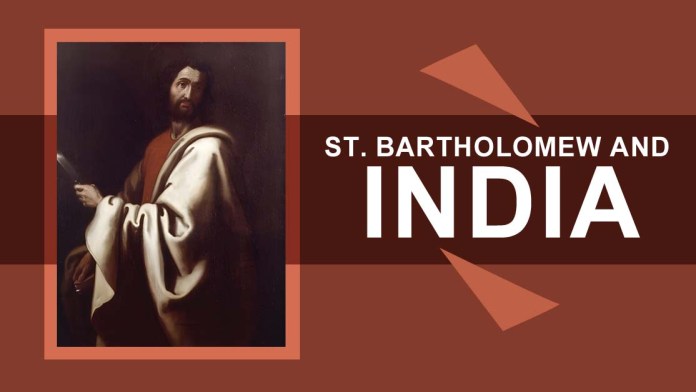
When Eusebius writes about the Indian mission of Pantaenus, makes reference to the Christians who had in their possession the Gospel of St Mathew brought to them by St Bartholomew. Eusebius wrote as the following: For Bartholomew, one of the apostles, had preached to them and left with them the writing of Mathew in the Hebrew language which they had preserved till that time (Eusebius, Historia Ecclesiastica 5.10). This account by Eusebius confused the historians with regard to the identity of India and also with regard to the identity of the apostle who preached in India. Pantaenus visited the Proper India or some other countries like Arabia or Ethiopia, which were often confused with India by certain writers of earlier times; and whether it was St Thomas or St Bartholomew who evangelized India.
Eusebius is certain that Pantenus visited India. The accounts of many Church Fathers confirm the same. The problem is then with regard to the Gospel of Mathew found in India which had been given them by Bartholomew. Both Eusebius and Jerome agree in this statement. The reason why Eusebius wrote so was that he was following the Alexandrian tradition. Alexandrian tradition does not connect St Thomas with India. According to them St Thomas preached in Parthia, and St Bartholomew in India. Parthia and India was the same that time or it was Indo-Parthia according to the modern understanding. Eusebius and Jerome simply confused India with Arabia and Persia as was often done by the classical writers of the time (For details see E.H. Warmington, Commerce Between the Roman Empire and India, London 1974, 13). They are not against the apostolic origin of the Indian Church. But they ascribe St Bartholomew as the apostle of the East including India. But St Bartholomew ‘the Apostle of Armenia’ and missionary to Arabia and Persia has nothing to do with India, is the opinion of most of the Indian historians (S.H. Moffet, A History of Christianity in Asia, Vol. I, New York 1992, 38).
Thomas is the apostle of India and Bartholomew is the apostle of Armenia. As Thomas preached gospel in some part of Persia and Syria, Bartholomew too preached in Arabia and Persia. There are different interpretations for this Bartholomew riddle. According to one interpretation it supposes a lapse in communication between the Indian Christians and the Alexandrian scholar Pantaenus. When he asked the faithful whether they had a copy of Bible with them they answered him that they had a copy of St Mathew from the time of ‘Marthoma’. But it was sounded in the foreign ears of Pantaenus as bar-tholmai. Thus was the origin of the story of Bartholomew as the apostle of India emerged through mistaken identity.
Another interpretation is as the following. St Thomas Christians were making pilgrimages to the tomb of St Thomas at Mylapore. This was called pilgrimage to Beth-thoma, meaning ‘house of Thomas’. This expression ‘beth-thoma’ could be sounded as ‘bar-tholmai’ and he took it as ‘Bartholomew’. Thus through Pantaenus this ‘Bartholomew episode’ spread in Alexandria. And from Alexandrian circle Eusebius and Jerome got this false identity of the Indian apostolate. Though we find some patristic writers connecting Bartholomew with India, the Bartholomew tradition in India is not a living tradition unlike that of St Thomas which is a very living tradition.
Rev. Dr. James Puliurumbil
