


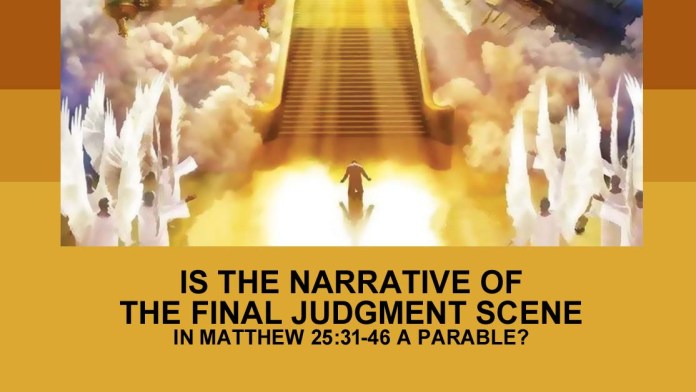
The narrative of the Final Judgment in Matthew 25:31-46, though having a parabolic element in verses 32b-33, is not a parable. Matthew has certainly used parables told by Jesus in other parts of his Gospel ((Matt 11:16; 13:3,10). When Jesus speaks parable, he introduces it as a parable (Matt 13:19; 21:33) or the evangelist introduces the parable (Matt 13:24, 31,33; 21:1-2). The crowds ask for an explanation of the parable spoken (Matt 13:36). Another way to know if Jesus is telling a parable is that He uses words or phrases such as “like” or “similarly” (Matt 13:44,47; 20:1; 25:1,14), “may be compared” (Matt 19:23) when he begins or ends the parable. Certain parables are begun with a question (Matt 21:28, 24:45).
Matt 25:31 is about an event that is going to happen in future. Then, in that event (vv. 32 and 33) Jesus will separate persons of all nations like a Shepherd separates sheep from goats. This is the only parabolic form here. There is no indication that the whole event is presented in parabolic form. In Matthew, there are such narratives, in which there are similes to clarify some part of them, and those narratives are not parables (Matt 5:13,16; 7:24,26; 10:16; 15:26,27; 17:2; 19:24; 23:27,37).
The depictions of the ‘poor’ in our text (Matt 25:35-36 & 42-43) are not parabolic. Jesus speaks about ‘really hungry person,’ not symbolically or figuratively hungry; He speaks about ‘really thirsty person,’ not symbolically thirsty or figuratively thirsty…etc. Here Jesus speaks about ‘real people who need food, drink, shelter and other necessities of life.’ These are physical needs in the present time. Jesus also speaks that fulfilling these needs of the real people enriches the spirit of those who give and of those who receive. This act prepares them to enter into the future life for eternal happiness. The language which Jesus speaks is real and direct. His saying is not parabolic, symbolic or figurative.
Thus, Matthew 25:31-46 is not a Parable, although there is one parabolic saying in the passage. It is a prophetic tradition by the Son of Man. The message of the Last Judgment scene is presented as a serious discourse in Matthew’s Gospel. This passage has no parallels in other Gospels or anywhere else. Here we see a non-metaphorical and powerful presentation of the most serious and important teaching of Jesus. The passage is presented in a very solemn setting. The division into five Narratives and Five Discourses is an essential factor in the composition-structure of the Gospel of Matthew. The message of this eschatological discourse, last and climax of all the five Discourses, is serious and non-metaphorical, as it touches the very final inheritance of the aim of human life.
Rev. Dr. Antony Plackal, V.C.
