



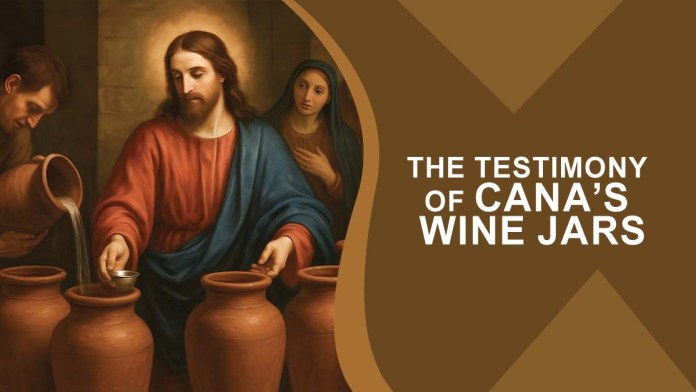
In the miracle that Jesus performed at Cana, the Evangelist records that six stone jars were filled to the brim with wine. He further indicates their size, saying that each jar could hold “two or three measures” (metretas duo ē treis). A measure (metretas) was the unit used in those times to calculate liquid capacity, roughly equivalent to our modern liter. Based on this, one measure equaled nine gallons, or about 40 liters. Thus, when a stone jar was filled to the brim, it contained 27 gallons, or 120 liters, of wine. Altogether, the six jars held 162 gallons, or 720 liters. This was not only sufficient for the wedding feast at Cana, but would have been more than enough for many weddings to follow. Some biblical commentators (C. S. Keener, F. J. Mokmy) even note that 162 gallons is about the same quantity as the water in a small pool in which a person could swim. This abundance of wine at Cana stands as a strong testimony to God’s generosity. As the beloved disciple himself affirms, God does not give His Spirit in measure.
Yet the miracle at Cana and the abundance of wine point not only to the generosity of God, but also to the fulfillment of Old Testament prophecies regarding the Messianic age. In the Scriptures, the abundance of wine is presented as a sign and symbol of the day of the Lord’s salvation, of the coming of the Messiah, and of the age to come. There are many prophetic passages that declare that on the day of the Lord’s salvation, wine will flow in abundance (Hos 14:7; Amos 9:13–14; Jer 31:12; Zech 10:7; Joel 2:21–24). On his deathbed, Israel, foreseeing with the eyes of faith the future king to arise from the tribe of Judah, prophesied: “He will tether his donkey to a vine, his colt to the choicest branch; he will wash his garments in wine, his robes in the blood of grapes” (Gen 49:11). The abundance of wine at Cana is thus a sign: the glory of the Lord has drawn near to His people, the days of salvation have dawned, and the era of the Messiah, the true heir of Judah’s scepter, has arrived.
The Old Testament apocryphal writings also echo this prophecy of abundant new wine in the Messianic age. The Book of Enoch (1 Enoch 10:19) and the Second Book of Baruch (2 Baruch 29:5) describe a time when every vine will produce a thousand branches, each branch a thousand clusters, each cluster a thousand grapes, and each grape will yield 120 gallons of wine. John’s description of six stone jars each holding “two or three measures” resonates deeply with these prophecies. According to the calculations: if three measures filled the jars, they held 162 gallons; if two, then 120 gallons. In both cases, the quantity matches precisely the prophecy of 2 Baruch and Enoch-120 gallons from a single grape. Thus, John’s meticulous description of six jars each holding two or three measures is not meaningless, nor, as some suggest, merely an indication of the incompleteness of the Old Testament or of Jewish ritual. Rather, it reveals a profound theological truth: that Jesus of Nazareth is the Messiah who brings the abundance of new wine foretold in Scripture.
John refers to the miracles of Jesus as “signs” (sēmeia). Signs are supernatural works that convey a deeper message beyond what is visible to the eye. The miracle at Cana, too, was such a sign. Beyond the visible abundance of wine, it proclaimed the dawn of the Messianic age.
Rev. Dr. Tom Olikkarott
