



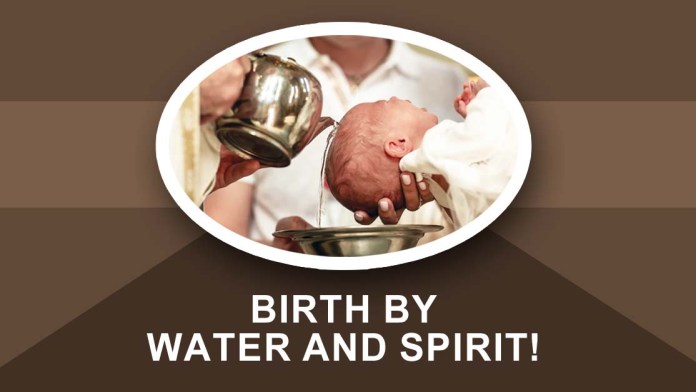
As a condition for entering the Kingdom of Heaven, Jesus tells Nicodemus, you must be born from above. When Nicodemus, unable to understand the deeper meaning of this teaching, becomes confused, the Messiah clarifies the method of rebirth: “Unless one is born of Water and the Spirit, he cannot enter the Kingdom of God.” What does Jesus mean by “Water and the Spirit,” the mediums of this new birth?
Biblical scholars have interpreted the phrase “born of Water and the Spirit” in three main ways: First, being “born of Water” is understood as a symbol of baptism. Baptism purifies the soul from both original sin and, if present, actual sins. The second action, the birth in the Spirit, takes place after the first birth through baptismal Water. The primitive Church viewed baptism as both a necessity and the initial step toward receiving the Spirit. Thus, this aligns with their perspective.
Second, the symbolic interpretation by St. Origen is noteworthy. According to him, the words of Jesus-“of Water and the Spirit”-refer to the action of the Spirit of God Himself, who cleanses and anoints. This interpretation resonates closely with Old Testament thought. In many places in the Old Testament, Water and spirit are used as symbols of God’s purifying and life-giving activity (cf. Isaiah 55:2–3; Jeremiah 2:13; Zechariah 14:8).
Third, within the historical context of Jesus and Nicodemus, another interpretation is possible. Their contemporary, John the Baptist, was preparing people for the baptism in the Spirit by giving them a Water baptism. The Gospel writers refer to John’s baptism as a “baptism of repentance.” In this context, being “born of Water” can be understood as the baptism of repentance, and being “born of the Spirit” as belief in Jesus of Nazareth. In summary, “being born of Water and the Spirit” means the foundational proclamation of the early Church: “Repent and believe in the Gospel.”
According to the Gospel of St. John, Water is a powerful symbol assisting divine revelation. John uses Water symbolically on multiple occasions. First, at the wedding in Cana, the six stone jars of Water play a key role in the revelation of Jesus’ glory. Similarly, in the conversation with the Samaritan woman, the setting is Jacob’s well and its Water. Again, Water is used as a symbol of the Holy Spirit in the expression “streams of living Water” (John 7:39–41). Finally, as a sign of the salvation brought about through the sacrificial death of the Messiah, the beloved disciple testifies that blood and Water flowed from His pierced side.
Considering this richness of symbolism, what could Jesus have meant by “Water” in the phrase “born of Water and the Spirit”? Clearly, the term “Spirit,” as John uses elsewhere, cannot apply to “Water” in this instance. To say “born of the Spirit and the Spirit” would not be linguistically or logically correct. Therefore, the “Water” here must be understood as referring to the Word. In the conversation with the Samaritan woman, Jesus uses “Water” in this same sense. Thus, “born of Water and the Spirit” should be rightly understood as new birth through the Word of God and the Spirit of God. Before life in the Spirit begins, it is the Word that becomes the fertile ground for the new creation.
“You have been born again, not of perishable seed, but of imperishable, through the living and enduring word of God.”
– 1 Peter 1:23
Rev. Dr. Tom Olikkarott
