



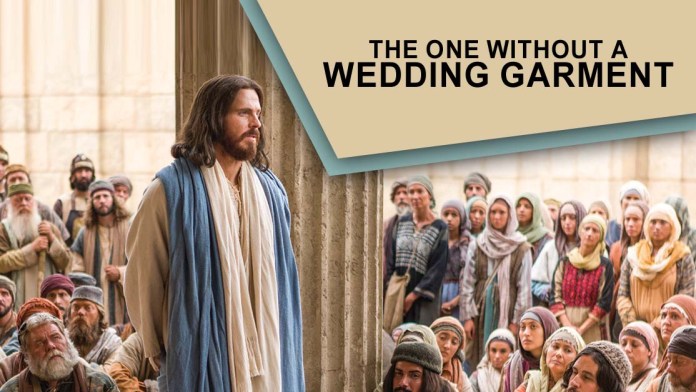
In the parable of the Wedding Feast (Matthew 22:1-14), many raise the question of why the king cast out the guest who entered the banquet hall without wearing a wedding garment. After the feast was prepared, one of those called from the crossroads was the person who did not wear a wedding garment and was consequently thrown out by the king. Those at the crossroads are not typically individuals prepared to attend a banquet. Therefore, the question arises: how can the act of expelling this guest for not wearing a wedding garment be justified? This is a relevant and thought-provoking query.
In the Gospel of Matthew, the “Parable of the Wedding Feast” (22:1-14) appears to be a combination of two distinct parables spoken in different contexts. Scholars believe that verses 2 to 10 refer to the Parable of the Wedding Feast, while verses 11 to 14 are about the Wedding Garment. It is likely that St. Matthew combined these two parables, originally narrated by Jesus as separate teachings, into a single account. Following the Parable of the Wedding Feast, the Parable of the Wedding Garment was added. This chapter begins with the phrase, “Jesus spoke to them again in parables” (22:1), using the plural form. Since there are no other parables in chapter 22, it becomes evident that the two distinct parables are included here. Treating these distinct parables as a single unit raises interpretative challenges. While the parables might seem related, their messages differ significantly.
The parable of the Wedding Feast in Matthew 22:2-10 reminds us that if the specially chosen Jews do not remain faithful and respond favourably to the call they received, the joy of divine salvation will be extended to the Gentiles and those marginalized by society. This serves as a warning to the Jews. However, the parable of the Wedding Garment in verses 11-14 conveys that merely being invited does not guarantee experiencing the joy of divine salvation. It emphasizes that those invited must live worthily in order to attain salvation.
The indication that two separate parables are recorded in Matthew 22:1-14 can be drawn from the parable of the banquet found in the Gospel of Luke (14:15-24). While Luke records the parable of the banquet with slight differences, he does not include the details related to the wedding garment found in Matthew 22:11-14. This suggests that the aspects concerning the wedding garment are not part of the parable of the Wedding Feast. If these were a unified parable, the Synoptic Gospel writer, Luke, would likely have included them as well. It is also noteworthy that a parable similar to the one about the wedding garment, as recorded in Matthew 22:11-14, was prevalent among the Jews during that time.
In summary, Matthew 22:1-14 records two parables that Jesus spoke in different contexts, placed one after the other. While it may seem that the latter verses (11-14) are a continuation of the first parable (2-10), they are, in fact, a separate parable. Treating these two parables as a single narrative naturally gives rise to the aforementioned doubt. However, understanding that the Parable of the Wedding Feast (2-10) and the Parable of the Wedding Garment (11-14) were spoken in distinct contexts and are unrelated resolves the raised question.
Rev. Dr. Antony Vadakkekara V.C.
