



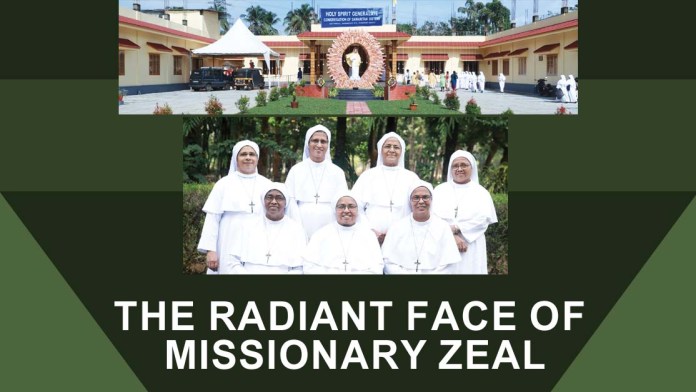
When the Damian Leprosy Institute was established at Mulayam in the early 1950s, Rev. Fr. Paul Chittilappilly, a priest of the then Diocese of Thrissur and a lecturer at St. Thomas College, had but one aim: to rehabilitate and care for the destitute leprosy patients who wandered through the streets of Thrissur. It was for the administration of this institution and for the compassionate care of its inmates that the Congregation of the Samaritan Sisters was founded on 25 January 1961 in the then Diocese of Thrissur, now the Archeparchy of Thrissur. The inspiration behind the founding of this religious congregation was the call of Christ: “Go and do likewise” (Lk 10:37).
The charism of the congregation is to experience the tender and merciful love of God through a constant awareness of His presence and an intimate communion with Him, and to share this experienced love with the sick, the poor, and the suffering, especially those afflicted with leprosy, through loving and dedicated service. Compassion towards those who endure physical, mental, and spiritual suffering constitutes the very spirit of the congregation. Harmoniously integrating prayer and work, giving priority to apostolic activities aimed at the integral liberation of the human person, embodying the merciful love of God the Father, becoming a good neighbour to all in need, organizing ministries in accordance with the signs of the times, making themselves readily available for the service of the local Church, remaining vigilant against social evils such as hunger, suffering, ignorance, and neglect, and dedicating themselves wholeheartedly to missionary endeavours, these form the essential elements of the consecrated life embraced by its members.
The diverse apostolic ministries undertaken by the congregation include hospitals, nursing schools and colleges, homes for the aged, orphanages, nursery schools, day-care centres, craft and tailoring centres, schools for children with intellectual disabilities, rehabilitation centres for the mentally ill, institutions for patients suffering from HIV/AIDS, hostels for girls, as well as evangelization, counselling, women’s empowerment, family apostolate, and various social welfare initiatives. Elevated to the status of a Major Archiepiscopal Religious Congregation on 14 December 2001, the congregation today comprises around 430 sisters.
At present, the congregation has 77 convents and nine mission centres spread across various states of India, including Kerala, Tamil Nadu, Andhra Pradesh, Karnataka, Madhya Pradesh, Chhattisgarh, Maharashtra, Uttar Pradesh, Odisha, Jharkhand, Punjab, and Assam, as well as in Germany and Italy.
