



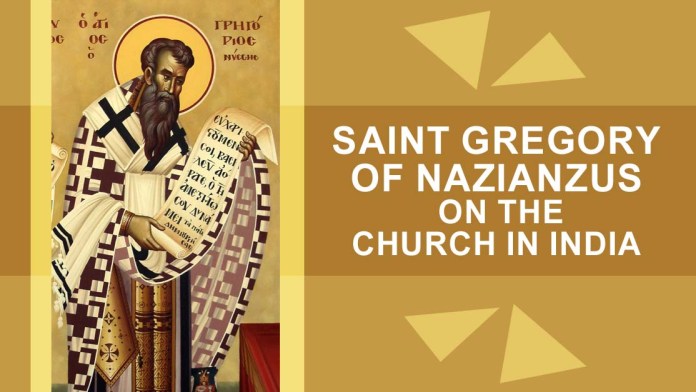
Saint Gregory, born in A.D. 329, was ordained a priest in 361. Soon afterward, his close friend Saint Basil consecrated Gregory as a bishop. However, for several years he did not actively administer his episcopal office but lived in solitude. After the death of his parents, and at the insistence of the people of Constantinople, he began serving as their bishop in 379. Later, he became Bishop of Nazianzus. The Greek Church recognizes Saint Gregory of Nazianzus as “the Theologian.”
In a sermon he delivered at Constantinople in 380, he spoke against the Arian heretics. On that occasion, he referred to the lands evangelized by each of the Apostles. He clearly stated that it was Apostle Thomas who proclaimed the Gospel in India. His words were as follows:
The lands in which the Apostles labored were not foreign to them. Everywhere they spread the light of the Gospel. Those who dwelt in the shadow of death received light. Peter preached in Judea; Paul among the Gentiles; Luke in Achaia; Andrew in Epirus; John in Ephesus; Thomas in India; and Mark in Italy.
The Apostles never considered the lands in which they worked as their own. They were governed by the conviction that they were appointed by God. God had said to the Israelites: “Whatever be the kingdom, you do not belong to the kingdom.”
What Sacred Scripture teaches, Greek philosophy also affirms: no human being belongs to this earth; no one has ownership over it. All are strangers here; the true homeland is heaven. Therefore, do not conform to this world; beware of being ensnared by its attractions.
Gregory clearly states that just as Judea was the missionary field of Peter, so India was the missionary field of Apostle Thomas. Gregory, who had studied at Athens — the renowned center of learning — had considerable knowledge about India. That is why Saint Gregory presents clearly and precisely that the apostolic field of Thomas was India.
Rev. Dr. James Puliurumpil
