



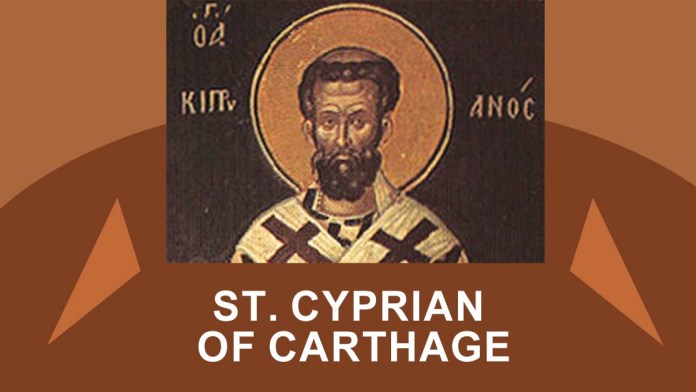
There are no clear historical records concerning the early life of Cyprian, who was born in Carthage around the year 200. Some historical sources indicate that he was born to wealthy pagan parents and was a distinguished orator. Cyprian began his professional career as a teacher of rhetoric. St. Jerome testifies that, through the influence of a priest named Caecilius, he embraced the Christian faith and distributed all his wealth among the poor (De Viris Illustribus 67). Having chosen a life of celibacy while still a catechumen, he was baptised around the year 246 and became a Christian. Not long after embracing the Christian faith, he was appointed Bishop of Carthage, either towards the end of 248 or at the beginning of 249.
Following the persecution of Emperor Decius, Cyprian fled Carthage in 250, but returned to his eparchy the following year as the intensity of the persecution had diminished. He presided over the Council of Bishops held in 251, which decided, among other matters, that those who had renounced the faith out of fear of persecution could be reconciled with the Church only on their deathbed, while even those who had obtained certificates of sacrifice by paying money, without actually renouncing the faith, could be recognised as official members of the Church only after undergoing a prolonged period of penance. In 254, a dispute arose between Cyprian and Stephen, the Bishop of Rome, concerning the readmission of those who had apostatised from the faith into the Church. The African bishops, under the leadership of Cyprian, opposed the decision of the Bishop of Rome to readmit bishops who had renounced the faith into the Church. Later, against the background of Bishop Stephen’s decision that baptism administered by heretics is valid when performed in the name of the Holy Trinity, Cyprian convened three African episcopal synods between 255 and 256. The councils unanimously decided that, just as there is no true faith or salvation outside the Church, baptism administered outside the Church is also invalid. It is evident that Cyprian’s convictions, such as “those who do not accept the Church as their mother cannot have God as their Father,” “the Church is the communion of the people of God united with the bishop,” and “the unity of the Church is manifested in the unity of bishops filled with the Holy Spirit,” influenced the decisions of the councils. On the basis of the view that “there is no salvation outside the Church,” Cyprian compared the Church to “Noah’s Ark” and had already gained wide recognition in the universal Church. The testimony of St. Jerome, “His writings are as clear and evident as the sun, so there is no need to draw up a list of them” (De Viris Illustribus 67), is evidence of his renown.
During the persecution under Emperor Valerian in 257, Cyprian was exiled to Curubis by the proconsul Paternus. In 258, Paternus’ successor Galerius ordered him to return to Carthage and sentenced him to death because he refused to offer sacrifice to pagan gods. Beheaded on September 14, 258, he is acclaimed as the first martyr among the African bishops.
Rev. Dr. Alex Sebastian Kollamkalam
