



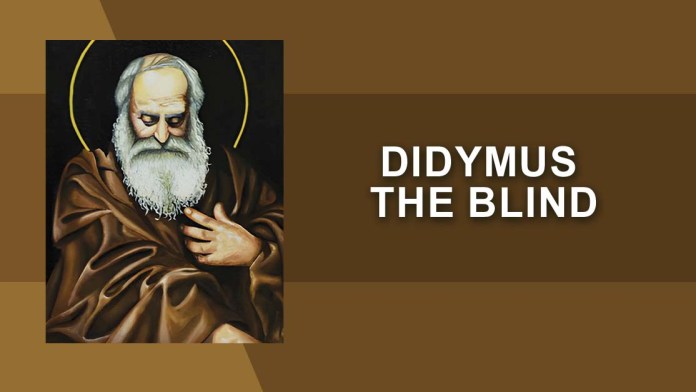
Historians testify that Didymus, who was born in Alexandria between AD 310 and 313, died at the age of 84. St. Jerome also testifies that Didymus was still alive and was 83 years old when he presented him in Chapter 109 of his work De Viris Illustribus (On Illustrious Men). Although he lost his eyesight at the age of four, Didymus succeeded in becoming one of the most learned men of his time. According to the historian Rufinus, he compensated for his loss of sight through his sense of hearing and committed everything he heard to the tablets of his heart. Within a short period, Didymus acquired profound knowledge of linguistics and Sacred Scripture. According to Rufinus, Didymus never prayed for the restoration of his sight during his youth. Rather, the inner vision of the heart was the subject of all his prayers. St. Athanasius, Bishop of Alexandria, appointed him head of the Catechetical School of Alexandria, a position he held for about fifty years. Rufinus was his disciple for six years. The historian Palladius visited him four times over a period of ten years, from 388 to 398. St. Jerome, for his part, stayed with him for a month and sought clarification from him on difficult passages of Sacred Scripture.
A complete commentary on the Psalms, commentaries on the Gospels of Matthew and John, two works against Arianism, a work on the Holy Spirit that was later translated into Latin by St. Jerome, eighteen volumes on the prophecies of Isaiah, three works commenting on the prophecies of Hosea, a commentary on the Book of Job, and a five-volume commentary on the prophecies of Zechariah are only some of his writings, according to Jerome (DVI 109).
The findings of later Councils, namely the Third Council of Constantinople (680–681) and the Second Council of Nicaea (787), that Didymus had repeated some of the theological errors of his revered Origen led to the destruction of many of his works. However, certain shortcomings in his theological studies do not diminish the value of his holy life. Though an unmarried layman, he demonstrated that even in the age of the Desert Fathers, it was possible to live an austere ascetical life while remaining in the city. His theological reflections on the Holy Trinity and Christology contributed to the development of the Church’s doctrinal teaching. It was for this reason that St. Jerome preferred the expression “Didymus the Far-Sighted” to “Didymus the Blind.”
Rev. Dr. Alex Sebastian Kollamkalam
