



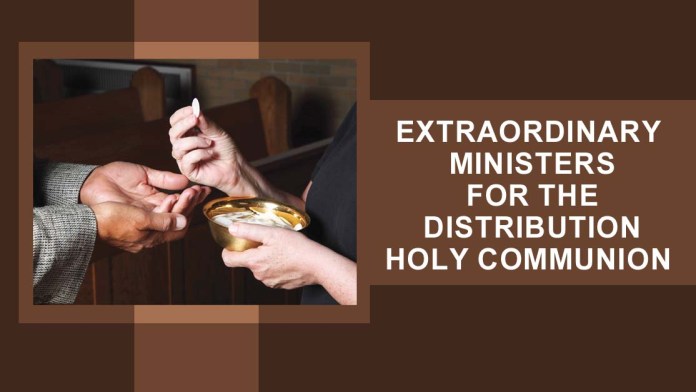
The Second Vatican Council teaches us that the Divine Eucharist is “the source and summit of the Christian life.” Therefore, the Church regulates with great care the ministries associated with the celebration and distribution of the Divine Eucharist. Ordinarily, the ministry of distributing Divine Eucharist belongs to those who have received Holy Orders. However, in certain pastoral circumstances and when there is a genuine need, the Church permits other members of the faithful to exercise this ministry. They are known as the Extraordinary Ministers of Divine Eucharist.
According to the law of the Latin Church (CIC), bishops, priests, and deacons are the ordinary ministers of Holy Communion (can. 910 §1, CIC). At the same time, an acolyte or another member of the Christian faithful who has been appointed in accordance with the norm of law (can. 230 §3 of CIC) is an extraordinary minister of Holy Communion (can. 910 §2 of CIC).
The Code of Canons of the Eastern Churches (CCEO) regulates this matter somewhat differently. According to can. 709 §1 of the CCEO, Divine Eucharist is to be distributed only by priests. A deacon may also distribute Divine Eucharist if the particular law of the respective Church sui iuris so provides. According to the Particular Law of the Syro-Malabar Church, deacons are also ordinary ministers of Divine Eucharist. As regards other members of the faithful, the Synod of Bishops of the Church sui iuris may determine whether they may be entrusted with this ministry (can. 709 §2, CCEO).
On this basis, the Particular Law of the Syro-Malabar Church establishes specific norms concerning extraordinary ministers of Divine Eucharist. According to the Particular Law of the Syro-Malabar Church, the following categories of persons may be appointed as extraordinary ministers of Divine Eucharist:
1. Major seminarians who have received at least the minor order of karoyusa;
2. Any perpetually professed member of a non-clerical religious institute;
3. Lay people of good standing, generally acceptable to the parish priest and to the people.
A person does not automatically become qualified for this ministry merely because he or she is a Catholic. The person’s participation in the life of the Church, moral conduct, public Christian witness, and acceptance among the faithful should also be taken into consideration.
Appointment as an extraordinary minister is not a permanent right to distribute Holy Communion; rather, it is a ministry entrusted to a person for a particular purpose in a determined period and according to the needs of the Church. When there are a sufficient number of priests available to distribute Divine Eucharist, extraordinary ministers should not be employed for this purpose. Likewise, only priests have the right to take and receive the Divine Eucharist by himself. The faithful are not permitted to take Holy Communion by themselves from the sacred vessels and consume it without receiving it from a minister.
The responsibility for appointing religious and lay faithful as extraordinary ministers rests with the eparchial bishop. The names of those who may be appointed for this ministry are to be submitted by the parish priests of the parishes where such a ministry is required, for the approval of the eparchial bishop. Once the necessary permission has been granted, the extraordinary ministers are to exercise their ministry according to the directions of the parish priest. They are also to distribute Divine Eucharist wearing the special but simple vestments approved by the eparchial bishop.
The handling and distribution of the Divine Eucharist is a ministry of great ecclesial significance. Therefore, the selection and formation of extraordinary ministers must be undertaken with particular care. Their formation should appropriately include instruction concerning a sound understanding of the Church’s faith in the Divine Eucharist, basic knowledge of the Church’s liturgy, the nature and character of the ministry of an extraordinary minister, and the proper manner of distributing the Divine Eucharist.
It is important to remember that an extraordinary minister is not merely a ‘practical assistant’. He or she is an ecclesial minister who, through personal life and service, manifests the Church’s faith in and reverence for the Divine Eucharist. The purpose of this ministry is solely to assist the ordinary ministers in responding to genuine pastoral needs, always with the utmost reverence for the Most Divine Eucharist.
Rev. Dr. Joshy Kulathumkal
