

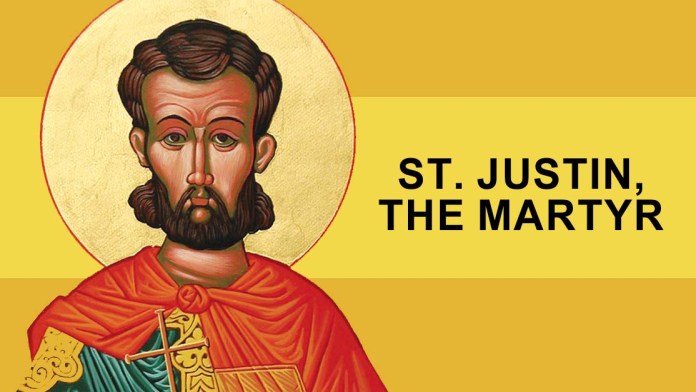
St. Justin, the Martyr

Published on

St. Justin was born around the year AD 100 into a pagan family in Neapolis of Palestine. In the course of his search for truth, he was trained in the Stoic and Platonic schools of philosophy. However, finding no true satisfaction in them, he turned to the study of the Sacred Scriptures. This ultimately led him to Christianity. Having embraced the Christian faith at Ephesus around AD 132, he thereafter travelled through various places teaching others this new philosophy, namely the Christian faith. Eventually, he arrived in Rome and established a school of theology there.

However, because of his propagation of the Christian faith in Rome, he was brought before the Roman Prefect and, together with his six companions, was put to death by beheading. He attained martyrdom by beheading around AD 165. The ancient work The Martyrdom of St. Justin and His Companions (Martyrium Sancti Justini et Sociorum) presents in detail the account of his martyrdom.

Although St. Jerome provides an extensive list of the writings of St. Justin in his work De Viris Illustribus (DVI 23), the most notable among them are the two Apologies addressed to Emperor Antoninus Pius and the Roman Senate questioning the unjust persecution of Christians, as well as the Dialogue with Trypho, which establishes the superiority of the Christian faith over Judaism.

Having realized through his own life that philosophy is a pathway leading to theology, he explained this relationship through the concept of the Logos Spermatikos. He taught that the Divine Word existed in the form of a seed among the prophets of the Old Testament and even among the Greek philosophers, and that its fullness is found in Jesus Christ.

Having sacrificed his life for the proclamation and defence of the faith, he is honoured in the
Church as one of the foremost among the Greek Apologists.


Rev. Dr. Alex Sebastian Kollamkalam

Latest Updates

POPULAR Views

FEATUERD Views

Mar Mari

Mar Mari, regarded as the first missionary to the Parthian Empire, was one of the Seventy Disciples of the Lord and a close disciple of his master, Mar Addai....

Saint Theophilusof Antioch

Born in the first half of the second century into a pagan family near the rivers Tigris and Euphrates (in a region that forms part of modern Iraq), Theophilus...

Saint Gregory the Wonderworker

Saint Gregory Thaumaturgus, known as the Wonderworker, was born around A.D. 213 in Neocaesarea, in a pagan family. His original name was Theodore. At about the age of fourteen,...

Gregory of Nyssa

Saint Gregory of Nyssa, one of the Cappadocian Fathers, was born into a deeply rooted Christian family. His mother, Emmelia, was the daughter of a martyr. His brothers, Basil...

Saint Gregory of Nazianzus

Saint Gregory of Nazianzus, who was born around AD 330 in Arianzus of Cappadocia in Asia Minor and died there around AD 390, is  acclaimed as β€˜Great’ among the...

St. Jacob of Sarug

Jacob was born in A.D. 451 in the town of Kurtam in Mesopotamia. After completing his primary education, he joined the theological school of Edessa. There he gained deep...

St. Ambrose of Milan

St. Ambrose of Milan, a member of a traditional Christian family in Rome, was born in 340 A.D. at Trier, the capital of Gaul, where his father Ambrosius served...

St. Clement of Alexandria

Titus Flavius Clemens, one of the Fathers of the Church known as the Apologists, was born around AD 150 in Athens to pagan parents. Having received education under several...

St. Hilary of Poitiers

St. Hilary of Poitiers was a bishop who was born in Poitiers, a town in the Gaul province of the Western Roman Empire, in the early decades of the...

St. Jerome

Among the four great Fathers of the Western tradition, St. Jerome is one. (The other three are St. Ambrose, St. Augustine, and St. Gregory the Great). The 135th chapter...

St. Jacob of Nisibis

Born into a wealthy family in Nisibis in the last decades of the third century, James renounced his home and property to lead an austere life of asceticism in...

Mar Aphrahat

Mar Aphrahat, also known by the epithet Persian Monk, was born to non-Christian parents during the final decades of the third century. He embraced the Christian faith during the...