

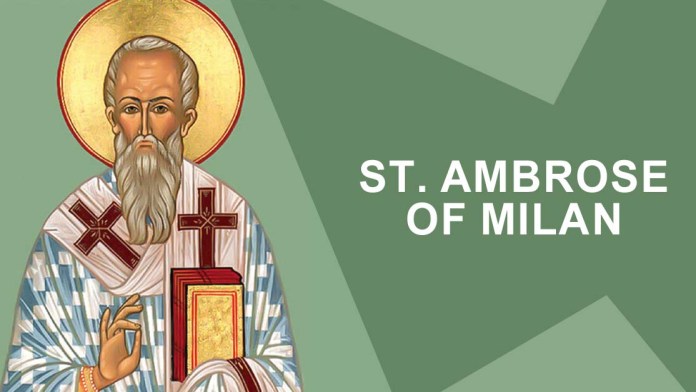
St. Ambrose of Milan

Published on

St. Ambrose of Milan, a member of a traditional Christian family in Rome, was born in 340 A.D. at Trier, the capital of Gaul, where his father Ambrosius served as the Prefect of Gaul. After the untimely death of his father in A.D. 354, he returned to Rome with his mother and two siblings. He attained mastery in law and became a well-known advocate. Recognizing his expertise in law, Emperor Valentinian appointed Ambrose as the Governor of Liguria-Emilia in 370, after which he shifted his residence to the official quarters in Milan.

After twenty years of anti-Church governance, when Auxentius, the Bishop of Milan and an Arian sympathizer, died in 374, other bishops sought the Emperor’s assistance to elect a new bishop. That responsibility was entrusted to Ambrose, the Governor. As he attempted to bring together the Arians and the Nicenes, who stood on opposite sides, both groups unanimously demanded that Ambrose himself should become the next bishop. At that time, he was only a catechumen; but after receiving baptism and the other sacraments, he was ordained bishop on December 7, 374. He then sold all his possessions and distributed them to the poor. To compensate for his lack of theological training, he dedicated the subsequent period to the study of Sacred Scripture and the Fathers of the Church (especially Origen and St. Basil). It was St. Ambrose who brought about the conversion of St. Augustine and administered his baptism. His proficiency in the Greek language and literature helped him engage in open dialogue with Greek theology. Taking a firm stand against Arian heresy, he courageously disregarded the Emperor’s order in 385–86 to hand over a Catholic church to the Arians. He remained the Bishop of Milan until his passing from this world in 397.

St. Jerome testifies (DVI 124) that he refrains from evaluating Ambrose because he was his contemporary and still alive at the time. Regarded as one of the greatest among the Latin Church Fathers along with St. Augustine, St. Jerome, and Pope St. Gregory, he was proclaimed a Doctor of the Church, and the Church also granted official recognition to his holy life. He is venerated as a heavenly intercessor for the city of Milan.

Latest Updates

POPULAR Views

FEATUERD Views

Mar Mari

Mar Mari, regarded as the first missionary to the Parthian Empire, was one of the Seventy Disciples of the Lord and a close disciple of his master, Mar Addai....

St. Justin, the Martyr

St. Justin was born around the year AD 100 into a pagan family in Neapolis of Palestine. In the course of his search for truth, he was trained in...

Saint Theophilusof Antioch

Born in the first half of the second century into a pagan family near the rivers Tigris and Euphrates (in a region that forms part of modern Iraq), Theophilus...

Saint Gregory the Wonderworker

Saint Gregory Thaumaturgus, known as the Wonderworker, was born around A.D. 213 in Neocaesarea, in a pagan family. His original name was Theodore. At about the age of fourteen,...

Gregory of Nyssa

Saint Gregory of Nyssa, one of the Cappadocian Fathers, was born into a deeply rooted Christian family. His mother, Emmelia, was the daughter of a martyr. His brothers, Basil...

Saint Gregory of Nazianzus

Saint Gregory of Nazianzus, who was born around AD 330 in Arianzus of Cappadocia in Asia Minor and died there around AD 390, is  acclaimed as β€˜Great’ among the...

St. Jacob of Sarug

Jacob was born in A.D. 451 in the town of Kurtam in Mesopotamia. After completing his primary education, he joined the theological school of Edessa. There he gained deep...

St. Clement of Alexandria

Titus Flavius Clemens, one of the Fathers of the Church known as the Apologists, was born around AD 150 in Athens to pagan parents. Having received education under several...

St. Hilary of Poitiers

St. Hilary of Poitiers was a bishop who was born in Poitiers, a town in the Gaul province of the Western Roman Empire, in the early decades of the...

St. Jerome

Among the four great Fathers of the Western tradition, St. Jerome is one. (The other three are St. Ambrose, St. Augustine, and St. Gregory the Great). The 135th chapter...

St. Jacob of Nisibis

Born into a wealthy family in Nisibis in the last decades of the third century, James renounced his home and property to lead an austere life of asceticism in...

Mar Aphrahat

Mar Aphrahat, also known by the epithet Persian Monk, was born to non-Christian parents during the final decades of the third century. He embraced the Christian faith during the...