



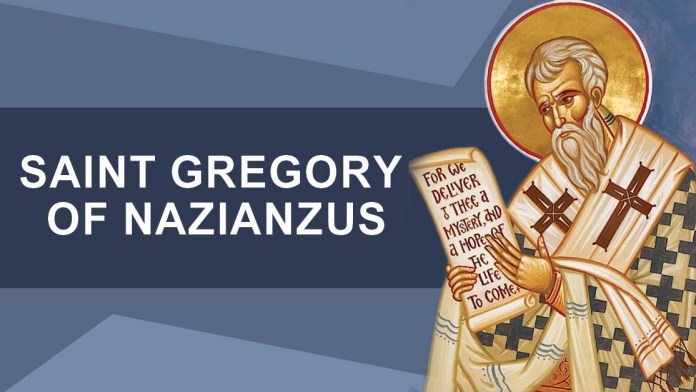
Saint Gregory of Nazianzus, who was born around AD 330 in Arianzus of Cappadocia in Asia Minor and died there around AD 390, is acclaimed as ‘Great’ among the Greek Fathers, together with Saint Basil, Saint Athanasius of Alexandria, and Saint John Chrysostom. Influenced by his mother, who lived a deeply rooted Christian life, Gregory’s father embraced the Christian faith and was ordained Bishop of Nazianzus in AD 325. Born after this event, Gregory grew up receiving formation not only in secular disciplines but also in the Christian faith.
He completed his studies first at Caesarea, then at Alexandria, and finally at Athens. Saint Basil was his fellow student at Caesarea and Athens, and the friendship forged during their years of formation continued until the end of their lives. Julian, later known as “the Apostate” and future Roman Emperor, was also their classmate.
After completing his studies, Gregory returned to Cappadocia and joined the monastic community founded by Saint Basil at Annesi in Pontus, leading a monastic life. However, compelled by his father, the Bishop, he accepted priestly ordination in AD 362 after months of preparation. Later, at the insistence of his friend Basil, who was Bishop of Caesarea from AD 371 to 379, Gregory consented in AD 372 to be appointed Bishop of Sasima. Yet, due to his natural aversion to positions of authority, he never formally assumed that office.
Following his father’s death in AD 374, Gregory guided the Eparchy of Nazianzus for nearly two years, but once again refused to officially assume the episcopal office. Toward the end of 375, he returned to monastic life and spent the next three years in prayer and study. Saint Jerome testifies that Gregory was the one who instructed him in Sacred Scripture (De Viris Illustribus, 117).
After the death of Saint Basil in AD 379, Gregory became the principal spokesman of Nicene orthodoxy in Asia Minor. That same year, Emperor Theodosius, who assumed leadership of the Eastern Roman Empire, decided to dethrone the Arian bishop of Constantinople and appoint Gregory in his place. The Ecumenical Council of Constantinople in 381 ratified this appointment. Nevertheless, citing opposition from a group of Egyptian bishops, Gregory declined to accept the position.
Thus, during the final nine years of his life, he was able to live a peaceful life of prayer in the monastery. When we profess in the Creed that the Holy Spirit proceeds from the Father, we may remember Saint Gregory of Nazianzus, who reserved the term “procession” specifically for the Holy Spirit.
Rev. Dr. Alex Sebastian Kollamkalam
