



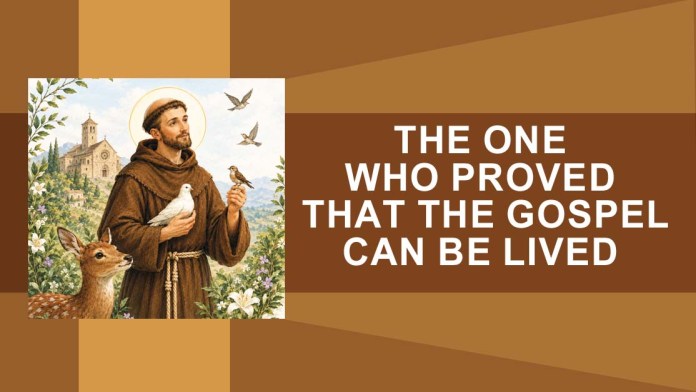
A messenger of peace who travelled from place to place, one who saw the divine presence in all creation and called every creature a brother or sister, an embodiment of true inner freedom, a prophet of joy, a revolutionary who took the side of the poor, a shining light in a dark period of the Church’s history, a support to a Church that was crumbling, a man granted insight into divine mysteries, one who received the sacred wounds of the Crucified in his own body… The Litany in honour of Francis contains many more such titles. But who, in truth, was Francis?
Eight long centuries have passed since St. Francis of Assisi died. Generations that followed have hailed him as the saint among saints and the second Christ, and venerated him as a patron of nature and environmental protection. People of different religions began gathering every year in Assisi, the home of Francis, to pray for world peace. In this age of crises, the world looks to him with hope, seeking to learn lessons of peace from his life. We do not need scholarly research papers or elaborate analyses to know Francis. We need only learn to see and think as he did. Such is the simplicity of Francis’s school of life.
Francis, who had lived a thoroughly worldly life, underwent a change of heart at the age of twenty-three. A profound transformation began when the image of the Crucified Christ in the Church of San Damiano appeared to come alive, and Jesus, speaking from the Cross, called Francis by name and asked him to rebuild His Church.
The life that followed became a love story, perhaps the most intense and deeply moving love story one could ever hear. Whether awake or asleep, in his thoughts or dreams, Francis saw the face of Jesus, especially the face of the Crucified. Their hearts spoke to each other. At last, Francis became entirely Christ’s own. Overwhelmed by the power of the love he had seen on the Cross, he longed to imitate Christ’s life in every detail. He embraced poverty as his beloved bride and desired to walk hand in hand with her until the end of his life. For Francis, poverty was also a means of becoming crucified with Christ, a way of renouncing everything he possessed for the sake of the One he loved.
Like an innocent child, Francis approached the Gospel of Jesus without prejudice or subsequent reinterpretations. It would hardly be an exaggeration to say that Francis of Assisi was the one Christian who refused to dilute the Gospel or compromise the demands of Gospel living. Perhaps this single quality made him a great saint and set him apart from others.
As the example of his life became a flame of love radiating the love of God, it spread to the hearts of many young people. They joined him, and together they grew into a community. Their humble community needed an established form, a rule of life, and the approval of the Church. Francis and his brothers went to Rome with a rule they had written themselves and sought the Pope’s approval. Seeing their poor attire and reading the contents of the rule they presented, the Pope and the members of his Curia may well have smiled inwardly. For the document contained only a few passages taken from the Gospels! It had none of the language, structure, or style of a formal legal text. Francis asked for nothing more than permission to live the Gospel.
After an initial dismissal and some dramatic developments, the Pope granted oral approval following a divine vision. This single episode is enough to reveal Francis’s unwavering desire to live the Gospel without conditions. His childlike simplicity and the poverty he embraced wholeheartedly drew him close to the heart of the Crucified Christ. Christ was taking shape in him, both inwardly and outwardly. Christ grew so visibly within Francis that those who saw him might have felt they were seeing Christ Himself. Jesus’ prayer, “I in them and you in me” (John 17:26), was being fulfilled in Francis almost literally. The five sacred wounds that God imprinted on Francis’s body were surely a sign of this union!
From the very first days of his conversion, Jesus had taught Francis the secret of transforming even life’s bitterest experiences into sweetness. Previously, nothing repelled him more than the sight of lepers. After coming to know Jesus, one day, while travelling, Francis encountered a leper whose appearance filled him with revulsion. He was about to turn away, covering his nose, when he remembered the words of Jesus: “I was sick and you took care of me” (Matthew 25:36). He immediately dismounted from his horse and embraced the leper. Francis later wrote about this experience in words that have become famous:
“…When I was in sin, the sight of lepers was extremely bitter to me. But the Lord Himself led me among them, and I showed mercy to them. …What had seemed bitter to me was then changed into sweetness of soul and body.”
In the years that followed, Francis learned to face the crosses of life courageously rather than seek to avoid them.
Francis’s life, lived in union with the Crucified Christ, was not one of gloom and sorrow; rather, it was filled with immense joy. Nothing could separate him from the joy he found in Christ. As Francis and his brothers travelled through the streets of Assisi, clapping their hands, singing, and dancing, people looked on in amazement. Although they possessed nothing in worldly terms, the joy reflected on their faces must have reminded those who saw them of the Beatitudes. Their witness may well have changed the direction and vision of many lives.
Even after eight centuries, that poor man of Assisi continues to proclaim loudly to the world: living the Gospel is possible!
Mr. Jose M. K.
