


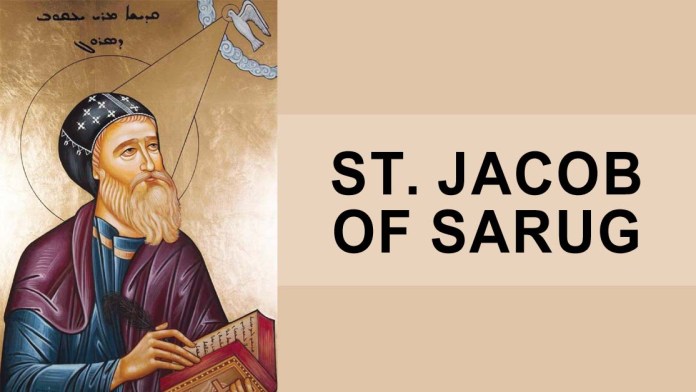
Jacob was born in A.D. 451 in the town of Kurtam in Mesopotamia. After completing his primary education, he joined the theological school of Edessa. There he gained deep knowledge not only in Sacred Scripture, liturgy, and the writings of the Church Fathers, but also in grammar, rhetoric, music, and mathematics. Unwilling to be drawn into the theological controversies that caused disputes at the great ecumenical councils of the fifth century (Ephesus and Chalcedon), he chose a life of prayer in the monastery at Hawra in Sarug.
Appointed as the Chorepiscopus of Hawra, he continued in that position until he was consecrated Bishop of Batnan, the capital of Sarug, in A.D. 518. He passed away on November 21, A.D. 521, at the age of seventy. He is venerated as a great scholar and saint of the Syriac Church. He enriched Syriac literature with 763 poetic homilies (memre), 43 letters, and eight festal homilies. An anaphora and a baptismal rite also bear his name. His distinctive contribution to Syriac poetry was the use of compositions written in couplets of twelve syllables each. Because of his unique literary style and profound spiritual vision, he earned the titles “The Harp of the Church” and “The Flute of the Holy Spirit.”
Rev. Dr. Alex Sebastian Kollamkalam
