



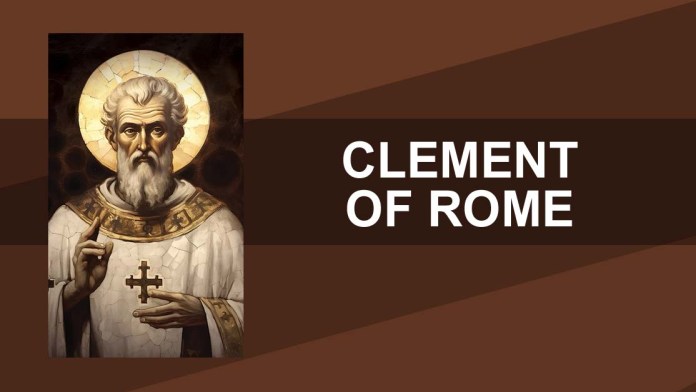
Clement of Rome, one of the seven Apostolic Fathers, was the fourth bishop of Rome after St. Peter, Linus and Anacletus. Tertullian and Epiphanius of Salamina put forward the tradition that he was consecrated directly by St. Peter but remained auxiliary bishop to Linus and Anacletus. According to Eusebius of Caesarea, his Papacy was from 92AD to 101AD (Historia Ecclesiastica 3,15,34). And St. Jerome testifies that he died during the third year of the rule of Emperor Trajan who ruled Rome from 98AD to 117AD (De Viris Illustribus 15). Though Origen, Eusebius and Jerome opine that he is the Clement found in Phil 4,3, the modern historians do not hold this position. Although many writings are attributed to his name, the Letter to Corinthians is the only authentic work from him.
Without mentioning his name, Clement begins this letter with the opening verse, ‘the Church of God sojourning in Rome to the Church of God sojourning in Corinth’ presenting it as a letter from one Church to another. The context of the letter is very clear from the very words of Clement himself: “that shameful and detestable sedition, utterly abhorrent to the elect of God, which a few rash and self-confident persons have kindled to such a pitch of frenzy, that your venerable and illustrious name, worthy to be universally loved, has suffered grievous injury” (Chapter 1). This letter was an answer to the request made by some Corinthians in the context of an upcoming schism in their Church. Clement realized that the jealousy of a few lay leaders to the Clergy was the real reason behind the schism. He narrates the story of Old Testament (Abel, Jacob, Joseph, Moses, Aaron and Miriam, Dathan and Abiram, David) and New Testament (Peter and Paul, other Apostles, the saints) figures who suffered due to the jealousy of other people.He also presents the examples of those who were saved by their obedience (Enoch, Noah, Abraham, Loth) and faith (Rahab). In this context, he advises the Church of Corinth to leave their jealous way of life and to embrace a life of humility after the model of Christ. He also insists that the authority of the clergy has its foundation in their apostolic succession and so the laity have no right to question them (Chapters 42-44). His attempt to explain the concept of the ‘resurrection of the body’ with example of Phoenix bird (Chapters 24-25) is also worth mentioning.
Rev. Dr. Alex Kollamkalam
