



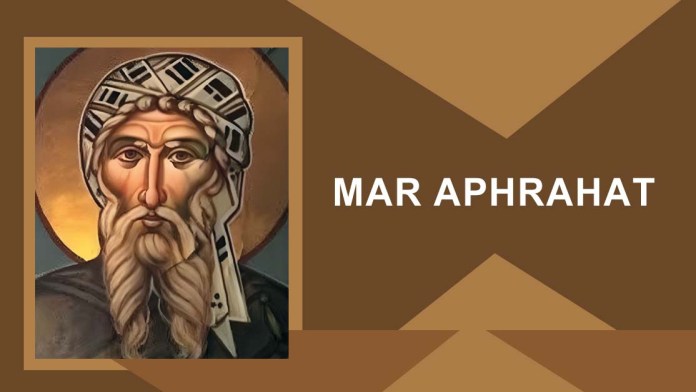
Mar Aphrahat, also known by the epithet Persian Monk, was born to non-Christian parents during the final decades of the third century. He embraced the Christian faith during the reign of the Persian king Shapur II (A.D. 309–379), a time marked by brutal religious persecutions. Subsequently, he entered into the ascetical life.
His only known work is a collection of twenty-three exhortations, titled Demonstrations, written between A.D. 337 and 345 for the benefit of his fellow ascetics. These are also the earliest extant writings of the Syriac Church Fathers available to us today.
Though some later historians have speculated that he might have been a bishop or abbot, this has not been universally accepted. A 14th-century manuscript refers to him as the “Bishop of Mar Mattai” — Mar Mattai being the name of a monastery that existed in the eastern part of Syria during Aphrahat’s time. The name Aphrahat is the Syriac form of the Persian name Farhād, which means “wise man”.
Born within the Persian Empire, he provides clear references to the socio-cultural setting of his time throughout his 23 Demonstrations. He testifies that he belonged to a monastic community called the “Sons of the Covenant” (Bnay Qyāmā, Dem. 6:4), and that he came to Christianity by renouncing pagan idols (Dem. 16:7).
In his writings, he adopts an acrostic literary style, using the 22 letters of the Syriac alphabet in order, with each Demonstration beginning with a successive letter. His Demonstrations cover a wide range of topics, including themes central to the spiritual life of the Church – such as faith, fasting, prayer, and humility – as well as issues of disagreement with Judaism, like circumcision, the Sabbath, and Passover.
Rev. Dr. Alex Sebastian Kollamkalam
