

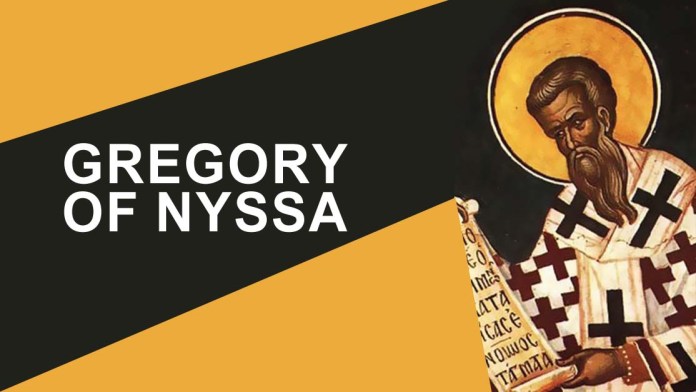
Gregory of Nyssa

Published on

Saint Gregory of Nyssa, one of the Cappadocian Fathers, was born into a deeply rooted Christian family. His mother, Emmelia, was the daughter of a martyr. His brothers, Basil the Great and Peter of Sebaste, were bishops; Basil of Cappadocia is revered among the Greek Fathers as β€œthe Great.” His elder sister, Macrina the Younger, is venerated as a saint upon the altar. Gregory’s first teacher was his elder brother Basil, whom he affectionately called β€œmy father and my master.”

Basil desired that Gregory, like himself, should be trained in theology and grow in Christian spirituality. Yet Gregory first pursued the art of rhetoric, began a teaching career, and married a young woman named Theosebia, entering family life.

In A.D. 371, when Basil became Bishop of Cappadocia, he appointed Gregory as Bishop of Nyssa, consecrating him by the laying on of hands. Later testimony from Gregory of Nazianzus affirms that Gregory lived with his wife thereafter in a manner akin to that of a brother and sister.

Upon assuming episcopal office, Gregory took a firm stand against the Arian heresy and emerged as a courageous defender of the true faith. Opposition from Arian circles made peaceful governance of his diocese difficult. He travelled to Arabia and Palestine, where he continued to proclaim orthodox teaching against Arianism.

Though he did not possess the same administrative skill as his elder brother, Gregory was distinguished by the depth and clarity of his theological insight. In A.D. 376, he was deposed from his episcopal office by Emperor Valens, but was reinstated in 378 during the reign of Gratian.

At the Council of Constantinople in A.D. 381, convened to oppose Macedonianism, which denied the full divinity of the Holy Spirit, Gregory was among the principal theologians. His discourse on the full divinity of the Son and of the Holy Spirit drew wide attention. He offered the Council theological clarity in affirming that the Holy Spirit proceeds β€œfrom the Father through the Son.” Historians also attest to his presence at a local synod held in Arabia in A.D. 394.

Latest Updates

POPULAR Views

FEATUERD Views

Saint Theophilusof Antioch

Born in the first half of the second century into a pagan family near the rivers Tigris and Euphrates (in a region that forms part of modern Iraq), Theophilus...

Saint Gregory the Wonderworker

Saint Gregory Thaumaturgus, known as the Wonderworker, was born around A.D. 213 in Neocaesarea, in a pagan family. His original name was Theodore. At about the age of fourteen,...

Saint Gregory of Nazianzus

Saint Gregory of Nazianzus, who was born around AD 330 in Arianzus of Cappadocia in Asia Minor and died there around AD 390, is  acclaimed as β€˜Great’ among the...

St. Jacob of Sarug

Jacob was born in A.D. 451 in the town of Kurtam in Mesopotamia. After completing his primary education, he joined the theological school of Edessa. There he gained deep...

St. Ambrose of Milan

St. Ambrose of Milan, a member of a traditional Christian family in Rome, was born in 340 A.D. at Trier, the capital of Gaul, where his father Ambrosius served...

St. Clement of Alexandria

Titus Flavius Clemens, one of the Fathers of the Church known as the Apologists, was born around AD 150 in Athens to pagan parents. Having received education under several...

St. Hilary of Poitiers

St. Hilary of Poitiers was a bishop who was born in Poitiers, a town in the Gaul province of the Western Roman Empire, in the early decades of the...

St. Jerome

Among the four great Fathers of the Western tradition, St. Jerome is one. (The other three are St. Ambrose, St. Augustine, and St. Gregory the Great). The 135th chapter...

St. Jacob of Nisibis

Born into a wealthy family in Nisibis in the last decades of the third century, James renounced his home and property to lead an austere life of asceticism in...

Mar Aphrahat

Mar Aphrahat, also known by the epithet Persian Monk, was born to non-Christian parents during the final decades of the third century. He embraced the Christian faith during the...

St. Irenaeus of Lyon

Irenaeus, who was born in Asia Minor during the first half of the second century, passed away between AD 200 and 203 while serving as the bishop of Lyon...

Mar Addai

Among the East Syriac Churches, the Anaphora of the Apostles used in liturgy is known by the names of Mar Addai and Mar Mari. Mar Addai, a disciple of...