


Wednesday, January 28, 2026
spot_imgspot_imgspot_img

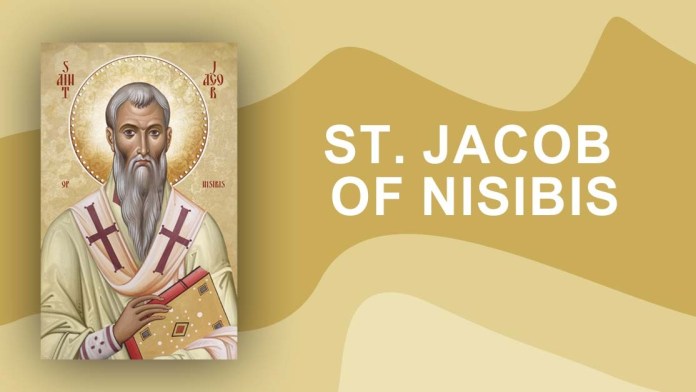
St. Jacob of Nisibis

Published on

Born into a wealthy family in Nisibis in the last decades of the third century, James renounced his home and property to lead an austere life of asceticism in the Mesopotamian mountains, as testified by Theodoret of Cyrrhus. He did not build a house or labor for food. He lived by eating what nature provided and residing in open places and caves. He wore clothing made from coarse goat’s hair (“The History of the Monks of Syria,” I, 2).

Attracted by the many miracles God performed through him, the people of Nisibis demanded that James be appointed as their first bishop, and he was consecrated bishop in A.D. 308. Though he had to move from the mountain to the city, he did not change his diet or clothing. He continued with rigorous fasting, wore sackcloth, and slept on bare ground even after becoming a bishop (Theodoret, “The History of the Monks of Syria,” I, 7).

Known as the father of the Church of Nisibis, James was the spiritual teacher of the prominent Syriac Church Father Mar Aphrahat and the founder of the theological school of Nisibis. Mar Aphrahat testifies about the Church of Nisibis, saying, “It was Mar Jacob who gave birth to her, fed her during infancy” (“Nisibene Hymns,” 14, 6).

He participated in the First Council of Nicaea and encouraged other council fathers to undertake fasting and acts of penance for the conversion of the seven bishops who secretly supported the Arian heresy (“The History of the Monks of Syria,” I, 10).

When the Persian king Shapur II attempted to capture Nisibis, which was part of the Roman Empire, it was the prayers of Bishop Mar Jacob that saved the city from destruction. Later, when the city fell to the Persian emperor in A.D. 363, the Christians, while fleeing the city, declared, “Had he been alive, this disaster would not have happened,” and took his relics with them (“The History of the Monks of Syria,” 11–12, 14).

Latest Updates

POPULAR Views

FEATUERD Views

St. Jacob of Sarug

Jacob was born in A.D. 451 in the town of Kurtam in Mesopotamia. After completing his primary education, he joined the theological school of Edessa. There he gained deep...

St. Ambrose of Milan

St. Ambrose of Milan, a member of a traditional Christian family in Rome, was born in 340 A.D. at Trier, the capital of Gaul, where his father Ambrosius served...

St. Clement of Alexandria

Titus Flavius Clemens, one of the Fathers of the Church known as the Apologists, was born around AD 150 in Athens to pagan parents. Having received education under several...

St. Hilary of Poitiers

St. Hilary of Poitiers was a bishop who was born in Poitiers, a town in the Gaul province of the Western Roman Empire, in the early decades of the...

St. Jerome

Among the four great Fathers of the Western tradition, St. Jerome is one. (The other three are St. Ambrose, St. Augustine, and St. Gregory the Great). The 135th chapter...

Mar Aphrahat

Mar Aphrahat, also known by the epithet Persian Monk, was born to non-Christian parents during the final decades of the third century. He embraced the Christian faith during the...

St. Irenaeus of Lyon

Irenaeus, who was born in Asia Minor during the first half of the second century, passed away between AD 200 and 203 while serving as the bishop of Lyon...

Mar Addai

Among the East Syriac Churches, the Anaphora of the Apostles used in liturgy is known by the names of Mar Addai and Mar Mari. Mar Addai, a disciple of...

St. Papias of Hierapolis

St. Papias, the Bishop of Hierapolis in Phrygia (modern-day Turkey), is considered one of the Apostolic Fathers. Both St. Jerome (De Viris Illustribus 18) and St. Irenaeus (Against Heresies...

Clement of Rome

Clement of Rome, one of the seven Apostolic Fathers, was the fourth bishop of Rome after St. Peter, Linus and Anacletus. Tertullian and Epiphanius of Salamina put forward the...

St. Polycarp of Smyrna (c. 156)

Polycarp, one of the Apostolic Fathers, served as the Bishop of Smyrna in Asia Minor. He became a martyr at the age of 86. One of the seven letters...

St Basil the Great (379)

St. Basil the Great, one of the three Ecumenical Fathers of the Greek patristic tradition, is celebrated as an apostle of love in the history of the Church. Born...