


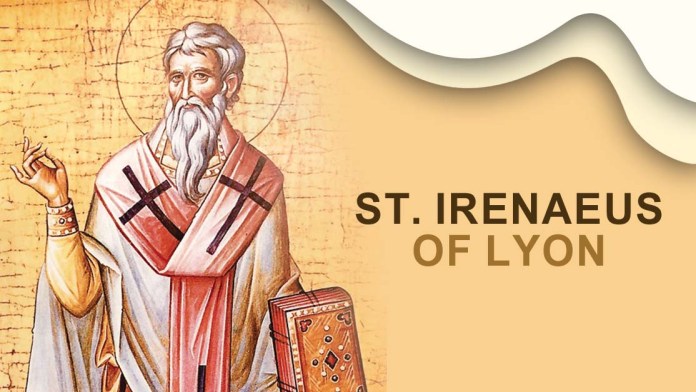
Irenaeus, who was born in Asia Minor during the first half of the second century, passed away between AD 200 and 203 while serving as the bishop of Lyon in Gaul. St. Jerome attests that Irenaeus was in Lyon during the reign of Emperor Commodus (177–192) (De Viris Illustribus 35). Irenaeus himself testifies that, in his childhood, he had directly heard St. Polycarp of Smyrna, who had been a disciple of St. John the Apostle. He writes:
“The events of that time are more clearly etched in my memory than those of recent years… the place where Polycarp sat and prayed… his way of life, his physical appearance, his sermons, the accounts he gave about his interactions with John the Apostle and others who had seen the Lord—all these I can vividly recall.” (Eusebius, Ecclesiastical History V, 20, 6)
When Pothinus, the then bishop of Lyon, became a martyr at the age of ninety, Irenaeus succeeded him in that position (Ecclesiastical History V, 5, 8).
Although several other works are attributed to him, Irenaeus is most renowned for his five-volume work Against Heresies (Adversus Haereses), written in opposition to the Gnosticism espoused by Valentinus. He also wrote against other heresies that were disturbing the peace of the Roman Church. His letter to the heretic Florinus is an example of this.
True to the meaning of his name—Irenaeus (from eirēnē, meaning “peace”)—he was a man of peace. When Victor, the head of the Roman Church, decided to sever ties with the Eastern Churches that did not celebrate Easter on Sunday, Irenaeus, then head of the episcopal council of Gaul, was a leading voice urging that the matter be handled with peace and love (Ecclesiastical History V, 24, 1–11).
On January 21, 2022, Pope Francis declared Irenaeus a Doctor of the Church, bestowing upon him the title Doctor of Unity in recognition of his life’s witness.
