


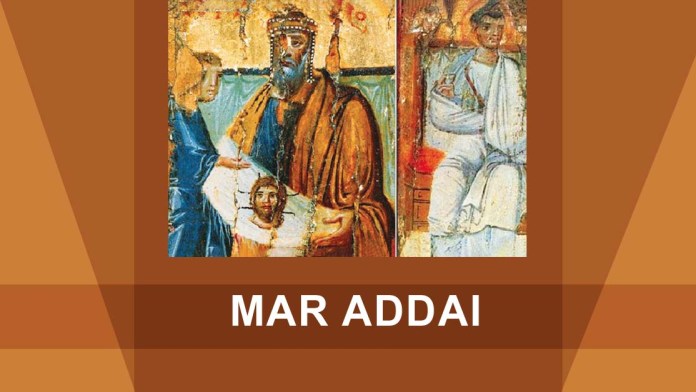
Among the East Syriac Churches, the Anaphora of the Apostles used in liturgy is known by the names of Mar Addai and Mar Mari. Mar Addai, a disciple of St. Thomas the Apostle, was one among the seventy disciples of Jesus, as attested by St. Eusebius of Caesarea (Ecclesiastical History I, 13.4). The book Doctrine of Addai also states that he was one among the seventy-two disciples of the Lord. Instead of the name Addai, Eusebius uses the name Thaddeus in his Ecclesiastical History.
It is further recorded that King Abgar of Edessa, having heard of the miraculous powers of Jesus, sent him a letter requesting Him to come and heal him. Jesus responded saying that He had to fulfill the responsibilities entrusted by His Father and that after He returned to the Father, He would send one of His disciples. The one sent to King Abgar to fulfill this promise was Thaddeus, also known as Addai. Eusebius affirms that he personally read the historical records concerning Abgar and Jesus from the archives in Edessa (Ecclesiastical History I, 13.5). Soon after the ascension of Jesus, it was St. Thomas the Apostle who sent Mar Addai to Edessa to proclaim the Gospel.
Hearing about the wondrous deeds performed by Addai in Edessa, King Abgar invited him to the royal court. When Addai entered the court, the king saw in a vision that St. Thomas the Apostle was standing alongside him (Ecclesiastical History I, 13.13), and the king paid him homage with deep reverence.
When King Abgar said that if not for the Roman authority, he would have sent an army to rescue Jesus from the Jews, it was Mar Addai who made the king understand that Jesus fulfilled the will of His Father. After placing his hands on the king’s head and healing him, Addai was asked by the king to preach about Jesus. Addai declared that he wished to preach the Lord publicly before the citizens of the kingdom (Ecclesiastical History I, 13.16,18,19). It was through Mar Addai that Edessa turned to the Christian faith. The people, after hearing his preaching, destroyed the pagan altars and received baptism, as testified in the Doctrine of Addai.
Although the king wished to offer gold and silver to Addai, he refused, saying, “I who have renounced even what is mine, how can I take what belongs to another?” (Ecclesiastical History I, 13.20).
According to the Edessan calendar, all these events took place in the year 340 (AD 30), and the testimony of Eusebius aligns with the witness of Tertullian, Lactantius, and Augustine, who state that Jesus died in AD 30. While the Doctrine of Addai testifies that Addai’s body was buried alongside the ancestors of the king, there is a historical error in the claim that his successor Aggai’s successor Palut received episcopal consecration from Serapion of Antioch (190–203).
Rev. Dr. Alex Sebastian Kollamkalam
