



Located about six miles from Fort St. George in Chennai and four miles southwest of Mylapore, Chinnamalai or Little Mount is a small hill rising approximately 80 feet above the surrounding landscape. The Portuguese called it Monte Pequeno. It is one of the three principal sites in Chennai traditionally associated with St. Thomas the Apostle. During the first century, when the region was covered with shrubs and dense woodland, the Apostle frequently withdrew to this secluded hill for prayer.
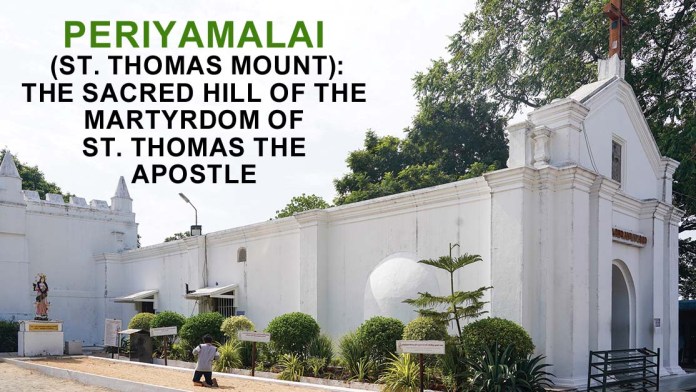
The second site in Chennai associated with St. Thomas is Periyamalai, better known today as St. Thomas Mount. This hill has often been described by historians as the Calvary of St. Thomas, for it was here that the Apostle, like his Divine Master, endured suffering and shed his blood in martyrdom. To distinguish it from Chinnamalai, it came to be known as Periyamalai (Tamil for “Great Hill”), while the Portuguese referred to it as Monte Grande. Historians and geographers alike commonly identify the site as St. Thomas Mount, a name that reflects its intimate association with the Apostle. The historic importance of these two hills is further emphasized by the famous Mount Road, which links them with the city of Chennai.
According to tradition, when the soldiers of the local ruler came in search of Thomas at Chinnamalai, he escaped to Periyamalai. It was while he was absorbed in prayer on this hill that the king’s attendants found him and pierced him from behind with a spear, bringing about his martyrdom. Thus, like the other Apostles, St. Thomas bore witness to his Lord by shedding his blood.
The disciples of the Apostle reverently carried his mortal remains from the hill to the nearby seashore, to the place that was first known as Beththuma and later as San Thome, where the present St. Thomas Basilica now stands, and there they buried him. According to the local tradition, the martyrdom of St. Thomas took place in A.D. 72.
From the earliest centuries, this sacred site has been regarded as a place of extraordinary spiritual grace, where pilgrims experienced the powerful presence of God. Historical records testify that Christians from Persia, Syria, Armenia, and other regions made pilgrimages to this holy place. The inscriptions found on the ancient tombstones at the foot of St. Thomas Mount continue to bear witness to this long-standing tradition of pilgrimage.
The tomb of St. Thomas and the place where it is situated occupy a unique and unparalleled position in Christian history. Moreover, the Apostle’s martyrdom at Mylapore and his tomb constitute the most compelling historical evidence for his apostolic mission in India. They remain enduring and irrefutable witnesses that cannot be erased or denied. Indeed, several foreign historians have argued that no further evidence is required to establish the Indian apostolate of St. Thomas, for his martyrdom and tomb themselves provide historical testimony of the highest credibility and authority.
Rev. Dr. James Puliurumpil
