



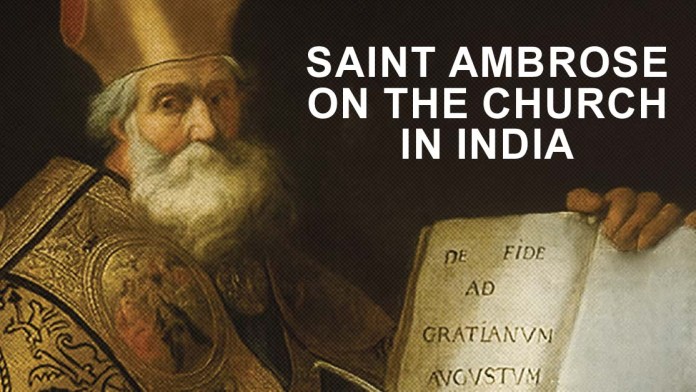
Ambrose, born in A.D. 340 as the son of the Roman Praetorian Prefect who governed Gaul (France), received baptism in November 374 while serving as the governor of the regions of Emilia and Liguria in Italy, and in December of the same year he was elected as bishop. He became bishop after giving away all his property to the poor. The conversion of Saint Augustine in 387 was one of the great events of his time. Another event was his publicly imposing penance on the Roman Emperor Theodosius for ordering the killing of certain people who had caused disturbances in Thessalonica. Ambrose died in 397.
Ambrose, a scholar well-versed in Latin and Greek writings, also possessed knowledge about India. His distinguished work “The Customs of the Indians” (De moribus Brahmanorum) bears witness to this. This book contains descriptions of the people of India, their customs, and many of its towns. Most significantly, this work also refers to Kodungallur-then known as Muziris-the place in Kerala where the Apostle Thomas landed. Ambrose himself explains at the beginning of the book why he wrote it. A man named Palladius approached him expressing the desire to know more about India. In order to give him a proper answer and to enlighten his own people further, Ambrose sent Musaeus, who was the bishop of Doléni, to India to understand more about that land as it was known then.
In this book Ambrose writes that Musaeus crossed many countries and many mountains and reached the distant land of India. It also states that this was the region of India visited long ago by Alexander. The lifestyle of the people here, the goods produced, and the ascetic practices of the monks all appear in the book. It testifies that this land lies very far from Europe. The book also makes special mention of the Apostle Thomas. Ambrose states clearly that it was the disciple of Christ, the Apostle Thomas, who proclaimed the Gospel in India, a land outside the Roman Empire. The book likewise mentions Persia, where the Apostle Matthew preached the Gospel. The text asserts that Thomas landed in Muziris (Kodungallur), then one of the major port towns located at the southern end of India, for the proclamation of the Gospel (PL 17, 1169). Therefore, this work stands as strong evidence for the apostolic ministry of Saint Thomas in India.
Rev. Dr. James Puliurumpil
