



At a festive ground, balloons rise high in the colours of the rainbow… A little boy stands watching them with curiosity as they dance with the wind. Looking at the collection of balloons of various colours in the hands of the vendor, he innocently asks: “Uncle, will this black balloon also fly?” Hearing the question, the man took a black balloon from his bundle, filled it with hydrogen, and released it into the air. Handing the string of the balloon that soared into the heights of the sky to the child, he said: “My child, it is not the colour, size, or brand of the balloon that makes it fly, but the hydrogen gas within it.”
Human life is similar. What elevates a person to greater heights is not one’s appearance, prestige, or status, but the divine vitality that dwells within. It is this divine beauty that energizes human choices with creativity and virtue.
What is Divine Vocation?
Divine vocation is the state of life freely chosen by a person, with full awareness, in the context of life situations and divine interventions, in order to attain the fullness of one’s existence. It is not merely a profession or a way of life, but a responsible response to God and to humanity. By surrendering our personal plans to God and interiorizing His plan within our hearts, it becomes a journey from ourselves towards God. As Pope John Paul II states: “Vocation is a mystery of love; it is God’s choice and the loving response of the human person.”
Different Expressions of Divine Vocation
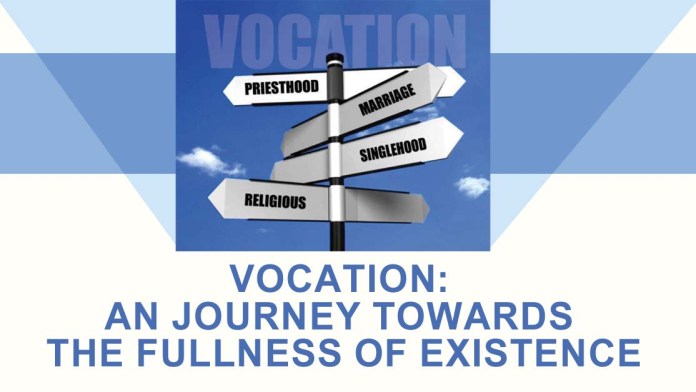
Divine vocation is manifested through various paths such as priesthood, consecrated life, family life, and single life. All vocations are equally holy and noble.
Priesthood: A life of dedication that stands as a bridge between God and humanity.
Consecrated Life: A call to live according to Gospel values and to be a faithful disciple of Jesus.
Family Life: Participation in God’s creative work and the foundational unit of the Church.
Single Life: A state of total dedication to God for selfless service.
Divine vocation becomes active when a priest stands for the people, when a religious shares in the sufferings of society, and when a family flourishes in love.
The Changing World and Its Challenges
In an age where humanity runs after the paradise promised by science and technology, spiritual perspectives are constantly shifting. As materialism and selfishness shake the very foundations of existence, success is measured merely in terms of wealth and status. In such a context, when exemplary lives become rare, the inner courage among the youth to move forward according to God’s will diminishes. Hence, the need to guide them in discerning the voice of God becomes increasingly urgent.
Silence Amidst Noise: The busyness of the digital world and the unnecessary noise surrounding modern life weaken the spiritual listening capacity of individuals. Therefore, special spiritual formation is needed to recognize the gentle voice of God amidst such distractions.
Resistance to Value Erosion: In a time when consumerism and secularism define success, young people need clear spiritual convictions to discern the path of true goodness.
Inspiring Courage: To surrender personal desires before the will of God and to choose a radical way of life (priesthood or consecrated life) requires great courage in today’s world. Such courage can be fostered through the guidance of elders.
Providing Direction: Amid the loneliness of the digital world and aimless pursuits, helping the youth understand that divine vocation leads to the fullness of existence can form a generation that does not lose its way.
Family: The School of Faith Formation
The family is the fundamental unit of the Church and society. Known as the “domestic Church,” it is the primary place of faith formation for an individual. It is within this context of love and culture that the foundation for priestly and consecrated vocations is laid. Families rooted in Christian values and virtues form the basis of priestly and religious vocations. However, today’s nuclear family culture, materialism, hedonism, “digital loneliness,” and the slavery to work often destroy the seeds of vocation. Spiritual paths marked by simplicity and service appear unattractive to many. A generation raised in comfort often struggles to cultivate the spirit of sacrifice and self-denial required to follow Christ. Distorted views on sexuality and addiction further lead the human intellect into bondage within the digital world.
The Need for Idealistic and Courageous Youth
Setting aside personal preferences and embracing a life of celibacy and simplicity in following Jesus may seem unattractive to the present generation. Yet, holy priests and consecrated persons are indispensable for leading the world to God. As Pope Francis affirms: “Where there are consecrated persons, there is joy. You are called to be prophets who can awaken the world.” As the Scripture reminds us, “The unmarried man is anxious about the affairs of the Lord… but the married man is anxious about worldly affairs” (1 Cor. 7:32–35), young men and women are called to come forward to serve with an undivided heart.
The words of Pope Francis, “Divine vocation is a witness to joy,” remind us that consecrated life is not merely the observance of rules, but a profound expression of joy arising from an encounter with Christ. The smile that blossoms on the face of one who embraces a vocation, even while renouncing worldly comforts, is a testimony that a treasure greater than the world has been found. This joy is not selfish; rather, it is a heavenly experience shared when one participates in the sufferings of others and becomes a refuge for the marginalized. The greatest message a person living according to Gospel values offers the world is that true fulfilment and joy are found in surrendering to the will of God. This joy, rooted in the assurance that one’s existence is secure in God’s love, transforms every vocation into an attractive witness before the world.
Conclusion
The decline in priestly and consecrated vocations is a serious crisis faced by the world today. Therefore, reverence for priestly and religious life must be fostered within our families. Young hearts desiring to live a radical life must be encouraged. May many young people arise in the Church as signs of the compassionate presence of the Nazarene. “Let us consider how to provoke one another to love and good deeds” (Heb. 10:24).
Sr. Dr. Jennis CSN
