



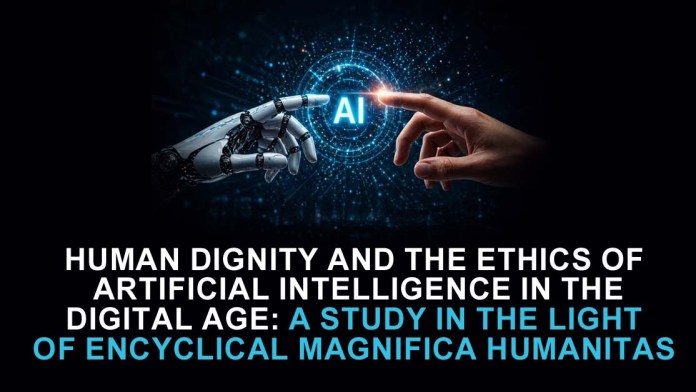
The global community today stands at the summit of an unprecedented digital revolution. As Artificial Intelligence (AI) and new media continue to transform the possibilities of communication, these developments cannot be viewed merely as technological progress. Even a digital gathering bringing together nearly a thousand participants from around the world is itself a defining characteristic of our age. It is within this context that the first encyclical of Pope Leo XIV, Magnifica Humanitas, assumes particular significance. Anyone seeking to understand the innovations of the present technological era will discover in this document profound reflections on how Artificial Intelligence should be approached with discernment. Beyond technology itself, the Holy Father presents a comprehensive vision centred on human dignity, which today faces threats in many different forms.
Catholic Social Teaching: A Historical Continuum
The Holy Father’s encyclical did not emerge in isolation; rather, it is the latest development in the Church’s long and rich tradition of Catholic Social Teaching. Beginning with Pope Leo XIII’s Rerum Novarum, the Church has consistently defended the dignity of labour and the rights of workers. Throughout history, the Church has opposed the concentration of wealth in the hands of a privileged few while poverty continues to increase. Successive Popes affirmed religious freedom as a fundamental human right.
Pope Francis, through his social teaching, courageously raised his voice against environmental exploitation and invited humanity to hear both the cry of the earth and the cry of the poor. By reaffirming the principle of the universal destination of goods and responding to the challenges of the present age, Pope Leo XIV’s Magnifica Humanitas becomes the newest expression of this living tradition of Catholic Social Teaching.
The encyclical clearly states that technology is never morally neutral. Instead, it proposes three fundamental principles of Catholic Social Teaching for evaluating technological development.
The first principle affirms that every human person is created in the image and likeness of the Triune God. Since the Trinity itself is a communion of Persons united in perfect relationship, the human person is by nature relational and cannot be understood in isolation.
The second principle is the equal dignity of every human being. Because God’s love is limitless, the able and the disabled, the healthy and the sick, the rich and the poor all possess the same intrinsic human worth.
The third principle concerns human rights. Human rights are an expression of human dignity. Significantly, it was Tertullian, one of the Fathers of the Church in the second century, who first employed the expression “human rights,” demonstrating that this concept has deep roots within the Christian tradition.
Human Dignity Under Threat: War and Modern Slavery
The threats confronting humanity today extend far beyond technology. Ongoing wars across the globe and the many forms of modern slavery continue to undermine human dignity. The Holy Father observes that even as technology advances, increasing numbers of people become marginalized. Calling for the emergence of a new culture of love, the encyclical strongly criticizes contemporary developments in which technological progress reduces the human person to a mere instrument or victim of machines.
Artificial Intelligence and the Crisis of Employment
The rapid expansion of technology is producing profound consequences in the world of work and the economy. Outlook magazine’s cover story, “The Slow Death of IT Sector Jobs,” vividly illustrates this reality. Nearly six million people in India depend upon the information technology sector for their livelihood, yet approximately 150,000 jobs were lost in the past year alone. Major corporations such as Microsoft, which laid off around 15,000 employees, and Amazon, which dismissed nearly 30,000 workers, continue large-scale workforce reductions. The principal reason is that Artificial Intelligence can perform many tasks more quickly and efficiently than human workers, prompting companies to replace human labour with automated systems.
Human dignity and self-worth are intimately connected with meaningful work and creative labour. Employment is not merely an economic necessity; it enables the human person to realize his or her vocation through productive activity. However, as Artificial Intelligence increasingly replaces human workers, individuals lose not only employment but also the dignity and self-respect that meaningful work provides. Pope Leo XIV expresses deep concern over this disturbing consequence of technological advancement in Magnifica Humanitas.
Modern Warfare and the Moral Failure of Artificial Intelligence
The recent conflict between Iran and Israel has been described by many observers as the world’s first full-scale “AI war.” Human intelligence alone could scarcely have coordinated attacks against nearly two thousand different targets within just ninety-six hours. Such military operations became possible through sophisticated Artificial Intelligence algorithms. Yet behind this extraordinary efficiency lay a profound moral failure.
During the early stages of the conflict, a school in Minab, Iran, was mistakenly bombed, resulting in the tragic deaths of approximately 180 schoolgirls. The building had once served as a base of the Iranian Revolutionary Guard but had later been converted into a school. Because the AI algorithms had not been updated with this crucial information, the system identified the location based on outdated military data. Consequently, innocent children lost their lives. This tragedy demonstrates the grave danger posed by technological systems that pursue efficiency while lacking moral judgment and human compassion.
Babel or Jerusalem: Two Contrasting Visions
To evaluate the world that humanity is constructing through Artificial Intelligence and modern technology, Pope Leo XIV poses a profoundly biblical question: Are we building a new Tower of Babel, or are we rebuilding the city of Jerusalem as Nehemiah did?
The story of the Tower of Babel reveals humanity’s attempt to build a monument reaching the heavens for the sake of pride, fame, and domination. Although technological expertise and human ingenuity were abundant, God had no place in the project. Babel therefore symbolizes self-sufficiency, arrogance, and the illusion of absolute human autonomy. It represents a civilization that sacrifices human dignity on the altar of efficiency and achievement.
The rebuilding of Jerusalem under Nehemiah presents a striking contrast. Before undertaking the reconstruction of the city’s walls, Nehemiah fasted and prayed, placing God at the centre of his plans. At the same time, he never overlooked the human person or human weakness. Before rebuilding walls of stone, he first united the people, encouraged their participation, and strengthened the bonds of community. His achievement was therefore not merely the reconstruction of physical structures but the restoration of authentic human relationships founded upon faith, cooperation, shared responsibility, and trust in God.
The Babel Syndrome and the Erosion of Human Personhood
The contemporary corporate world is increasingly afflicted by what may be described as the “Babel Syndrome.” It is a culture that elevates profit to the status of an absolute value. If human beings are no longer required to generate profit, they are readily replaced by machines, while human suffering is regarded as irrelevant to business interests. This mindset is driven by the ambition to control the entire world through a single digital language and technological framework.
Within such a culture, the profound mystery of the human person is reduced to mere data and performance. Individuals are evaluated solely on the basis of their productivity and utility, while the weak, the disabled, and the vulnerable are viewed as burdens upon society and consequently marginalized. In such an environment, grave moral violations such as abortion gradually cease to be regarded as ethical concerns.
The growing dependence on Artificial Intelligence in education further illustrates this danger. Students are now able to generate assignments and essays within minutes through AI tools, but this convenience comes at the cost of diminishing critical thinking, creativity, and the discipline of hard work. Although AI’s ability to solve mathematical problems that have remained unsolved for decades demonstrates its remarkable computational power, it simultaneously risks weakening the natural intellectual capacities of the human person.
Moral Principles for the Common Good
The encyclical proposes several fundamental moral principles to guide the regulation of the digital world and address the challenges posed by technological development.
The common good must remain the ultimate goal of every human activity, since the whole is always greater than the sum of its individual parts.
The universal destination of goods must also be applied to the digital age. Just as land, water, and air belong to the common heritage of humanity, so too should the new resources of our time—including patents, algorithms, digital platforms, and data—not become the exclusive possession of a privileged few. In today’s world, data has become a source of immense power, yet it must ultimately serve the good of all.
The principle of subsidiarity teaches that authority should not be concentrated exclusively in the hands of the State. Responsibilities that individuals, the Church, families, or other social institutions are capable of fulfilling should be entrusted to them rather than centralized.
The principle of solidarity reminds us that all people are created in the image of God and are therefore called to work together as members of one human family.
Finally, social justice demands that every person be guaranteed the opportunity to live a life worthy of human dignity.
Disarming Artificial Intelligence and Building a Counterculture
When decisions are driven solely by profit and efficiency, both humanity and creation inevitably become victims of exploitation. Today, the control of major digital platforms rests not primarily with democratic governments but with powerful multinational corporations. Their guiding principle is often not Christian morality or the common good, but commercial profit. In such a context, human intelligence, conscience, and freedom risk becoming subordinate to Artificial Intelligence itself.
Artificial Intelligence possesses neither a body nor lived experience. It knows neither joy nor sorrow, neither love nor suffering, and it has no moral conscience. Human beings, however, are far more than rational intelligence; they are persons who live through emotions, relationships, and moral responsibility. At a time when technological competition among corporations such as Google and NVIDIA increasingly resembles an arms race, Pope Leo XIV offers the compelling appeal to “Disarm AI.” Technology, he insists, must never become an instrument of rivalry, domination, or destruction.
Human dignity is not only a gift received from God but also a mission entrusted to humanity. We are called to cultivate and protect that dignity by disarming our speech and training ourselves for the work of peace. It is here that education assumes a decisive role. Through sound education, hearts must be formed to love truth and to seek wisdom. The Holy Father offers a striking new understanding of spirituality when he describes it as “being, becoming a wise architect”—that is, becoming a person prepared to build a world founded upon the common good.
Human limitations are not obstacles but opportunities for God’s mercy to be revealed and for authentic love to flourish. For this reason, genuine human relationships and physical presence must once again be restored beyond the confines of the digital world. Pope Leo XIV neither rejects technology nor views it as inherently negative. Rather, he calls for the formation of a new counterculture that confronts the challenges of the digital age while steadfastly upholding the dignity of the human person.
As the most recent contribution to the rich tradition of Catholic Social Teaching, Magnifica Humanitas provides the contemporary world with a compelling moral vision. Rather than allowing technology to dominate humanity, it challenges us to ensure that every technological advancement remains at the service of the human person, the common good, and the civilization of love. The encyclical thus offers not merely an ethical critique of Artificial Intelligence but a hopeful roadmap for building a future in which technological innovation and authentic human flourishing advance together under the guidance of wisdom, justice, and the Gospel.
Archbishop Mar Thomas Tharayil
