



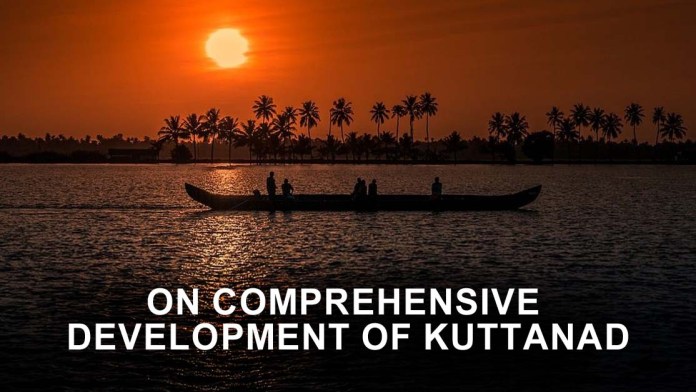
The major recommendations made in the J. B. Koshy Commission Report concerning Kuttanad are noteworthy not only for the Christian minorities of the region but for the stability and welfare of all communities residing there. Kuttanad, often described as the “Rice Bowl of Kerala,” has today become a land of hardships. The Commission rightly observes that instead of temporary solutions, permanent remedies are required. This report reflects a thorough and precise understanding of the region’s geography, agriculture, tourism, infrastructure, education, heritage, and culture. It proposes around forty-three recommendations aimed at preserving the ecological uniqueness of Kuttanad and making life sustainable in the region.
Traditionally, integrated land and water use-combining paddy cultivation, livestock rearing, fishing, duck farming, and coconut cultivation-has been the backbone of livelihoods in Kuttanad. Therefore, integrated farming systems that enhance agricultural intensity are especially relevant. The Commission recommends declaring Kuttanad as a special agricultural zone and enacting appropriate legislation related to land use.
Housing
Suitable housing schemes tailored to the conditions of Kuttanad must be implemented. Being a densely populated region, there is a need for expanded housing facilities. Land in possession prior to January 1, 2015, should be reclassified in the BTR register to make it suitable for residential construction. The financial ceiling for houses under the LIFE Mission should be increased for Kuttanad. Titles (patta) should be granted to places of worship, educational institutions, and houses established before 2001.
Water Management
Permanent solutions, modeled on countries like the Netherlands, should be adopted to control floodwaters. High bunds and shutters should be constructed by dividing the region into blocks. Projects must ensure access to safe drinking water for all. Rainwater harvesting schemes and water treatment plants should be established. Rivers and canals must be cleaned by removing waste and silt to ensure smooth water flow. During floods, high-capacity pumps should be used to remove water. At the Thottappally Spillway, powerful dewatering pumps should be installed to drain excess water into the sea.
Instead of letting river water flow away, systems should be developed to store and purify it for use during dry seasons. A special authority should be constituted for the protection of backwaters and wetlands, along with effective mechanisms to remove water weeds.
Paddy Cultivation and Other Agriculture
A special crop insurance scheme and a dedicated debt relief commission should be established for Kuttanad farmers. Financial institutions under government control should open branches in the region. Under the Pradhan Mantri Jan Vikas Karyakram, a special infrastructure development plan for Kuttanad should be implemented. The famous and high-quality Kuttanad “Puncha rice” should be granted a special trademark.
While fixing support prices, the increase in production costs—including wages, fertilizers, and pesticides—must be considered to ensure farmers receive a reasonable profit. Payments should be made at the time of procurement, and paddy should be collected immediately after harvest. Adequate compensation must be provided for crop loss due to floods, and agricultural debts should be fully waived. Modern rice mills should be established, and traditional seed varieties should be preserved with incentives. Systems for pest monitoring should be introduced, and production must be enhanced. Special schemes should also be initiated for animal and bird protection, and adequate compensation must be provided in cases of mass loss due to disease or other causes.
EWS (Economically Weaker Sections)
Farmers in Kuttanad who belong to economically weaker sections among the non-reserved categories are often denied EWS benefits on technical grounds. Due to recurring floods and crop losses, their primary agricultural land—paddy fields—does not yield sufficient income. While at least five acres are required for viable paddy cultivation, even farmers owning as little as two and a half acres are denied benefits. This anomaly must be corrected through appropriate government directives.
Considering the special conditions of Kuttanad, fee concessions, free hostel facilities, and travel concessions should be provided. Sports complexes should be established, job-oriented courses introduced, and free coaching centers started.
Tourism
For tourism development, grants should be provided to preserve ancestral homes over 100 years old. A heritage religious tourism circuit connecting the famous places of worship in Kuttanadu should be developed. Alongside tourism development, strict regulations must be enforced, including banning non-recyclable plastics. The Changanacherry–
Alappuzha tourism project should be implemented, and waterways in Kuttanadu should be developed for water tourism.
Healthcare Sector
Speedboat ambulance services should be introduced to ensure timely access to hospitals. Basic infrastructure in hospitals must be improved. Due to pollution of water and soil caused by waste and unscientific farming practices, there is an increase in differently-abled children. Special schemes for maternal and child care should be implemented.
An epidemiological survey on the high incidence of diseases in Kuttanad and studies on chronic toxicity should be conducted, followed by appropriate remedial measures. Special assistance schemes for cancer patients and the establishment of quality hospitals are also recommended.
Kuttanad is a designated Ramsar Site. Projects must be identified and implemented for its environmental protection. The report also recommends establishing an environmental and geographical research center in the name of I. C. Chacko. Altogether, the report presents a comprehensive set of recommendations aimed at preserving and developing Kuttanad. If implemented without delay, these measures can ensure that this unique land remains livable and enjoyable for future generations.
Antony Arilchira, Champakulam
(Retd. Deputy Tahsildar, Kuttanad)
