

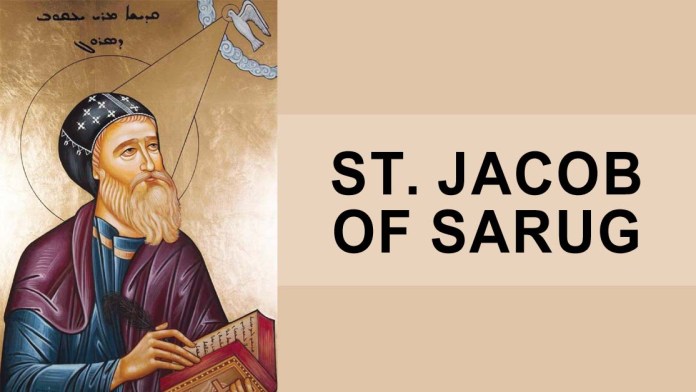
St. Jacob of Sarug

Published on

Jacob was born in A.D. 451 in the town of Kurtam in Mesopotamia. After completing his primary education, he joined the theological school of Edessa. There he gained deep knowledge not only in Sacred Scripture, liturgy, and the writings of the Church Fathers, but also in grammar, rhetoric, music, and mathematics. Unwilling to be drawn into the theological controversies that caused disputes at the great ecumenical councils of the fifth century (Ephesus and Chalcedon), he chose a life of prayer in the monastery at Hawra in Sarug.

Appointed as the Chorepiscopus of Hawra, he continued in that position until he was consecrated Bishop of Batnan, the capital of Sarug, in A.D. 518. He passed away on November 21, A.D. 521, at the age of seventy. He is venerated as a great scholar and saint of the Syriac Church. He enriched Syriac literature with 763 poetic homilies (memre), 43 letters, and eight festal homilies. An anaphora and a baptismal rite also bear his name. His distinctive contribution to Syriac poetry was the use of compositions written in couplets of twelve syllables each. Because of his unique literary style and profound spiritual vision, he earned the titles β€œThe Harp of the Church” and β€œThe Flute of the Holy Spirit.”

Rev. Dr. Alex Sebastian Kollamkalam

Latest Updates

POPULAR Views

FEATUERD Views

Mar Shemayon Barsaba

Following the death of Papa Bar Aggai, Mar Shemayon Barsaba became the Bishop of Seleucia-Ctesiphon and the Patriarch of the vast Christian community in the Persian Empire. The responsibility...

Mar Mari

Mar Mari, regarded as the first missionary to the Parthian Empire, was one of the Seventy Disciples of the Lord and a close disciple of his master, Mar Addai....

St. Justin, the Martyr

St. Justin was born around the year AD 100 into a pagan family in Neapolis of Palestine. In the course of his search for truth, he was trained in...

Saint Theophilusof Antioch

Born in the first half of the second century into a pagan family near the rivers Tigris and Euphrates (in a region that forms part of modern Iraq), Theophilus...

Saint Gregory the Wonderworker

Saint Gregory Thaumaturgus, known as the Wonderworker, was born around A.D. 213 in Neocaesarea, in a pagan family. His original name was Theodore. At about the age of fourteen,...

Gregory of Nyssa

Saint Gregory of Nyssa, one of the Cappadocian Fathers, was born into a deeply rooted Christian family. His mother, Emmelia, was the daughter of a martyr. His brothers, Basil...

Saint Gregory of Nazianzus

Saint Gregory of Nazianzus, who was born around AD 330 in Arianzus of Cappadocia in Asia Minor and died there around AD 390, is  acclaimed as β€˜Great’ among the...

St. Ambrose of Milan

St. Ambrose of Milan, a member of a traditional Christian family in Rome, was born in 340 A.D. at Trier, the capital of Gaul, where his father Ambrosius served...

St. Clement of Alexandria

Titus Flavius Clemens, one of the Fathers of the Church known as the Apologists, was born around AD 150 in Athens to pagan parents. Having received education under several...

St. Hilary of Poitiers

St. Hilary of Poitiers was a bishop who was born in Poitiers, a town in the Gaul province of the Western Roman Empire, in the early decades of the...

St. Jerome

Among the four great Fathers of the Western tradition, St. Jerome is one. (The other three are St. Ambrose, St. Augustine, and St. Gregory the Great). The 135th chapter...

St. Jacob of Nisibis

Born into a wealthy family in Nisibis in the last decades of the third century, James renounced his home and property to lead an austere life of asceticism in...