



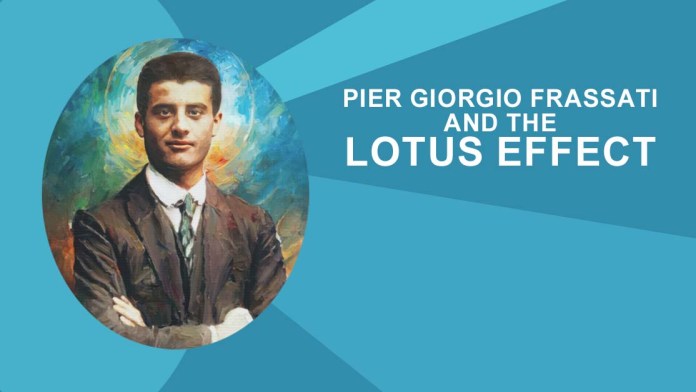
“Try to become saints of the 21st century” – these were the words Pope Francis spoke to the youth during his visit to Peru in 2018. These words opened the way for discussions among Catholics worldwide on what it means to be saints in the 21st century. The answer to this discussion was given when Pope Leo XIII declared Pier Giorgio Frassati a saint on September 7, 2025.
Born on April 6, 1901, in Turin, Italy, Pier Giorgio Frassati was a young Catholic who, in his short life, left an extraordinary mark of Christ’s presence on those around him. His deep personal faith and compassion for the poor often conflicted with the spiritual outlook of his own family. Being the son of a prominent journalist and having connections with high political officials in Italy and Germany, he could have pursued prestigious careers. Yet, Giorgio chose mining engineering, driven by the desire to help the poorest of society-the miners.
Frassati’s commitment to people was rooted in his deep devotion to God. Developing a profound spiritual life with his friends, he regularly attended the Holy Mass and spent hours in Eucharistic adoration, finding strength and inspiration in Christ’s presence. He would advise his friends: “Approach the Eucharist as often as possible with all the strength of your soul; consume the angels’ food that gives you power to face internal struggles.” Fond of mountain climbing, he discovered God’s presence in the mountains, praying the rosary during every journey. While living a devout life centered on the Church and helping the poor, Frassati also actively opposed the fascist regime in Italy.
When thousands of the poor attended his funeral in Turin, the world only then learned of the vast charitable work Frassati had done quietly, without public recognition. The tomb overflowed with flowers. Just as it seemed inevitable that Giorgio would be canonized, his body, when exhumed in 1981, was found perfectly preserved. During his beatification in 1990, Pope John Paul II described him as “a man of great blessings.”
“Live a life worthy of the calling you have received” (Ephesians 4:3). Can one live a holy life while being fully engaged with the social realities of one’s time? The Church’s answer to this question is Pier Giorgio Frassati. His life teaches that the measure of holiness is sensitivity to the age and society in which one lives.
Jesus chose not only holy places and like-minded people for his ministry but also the poor, the rich, sinners, officials, children, and scholars. In today’s world, is it possible to proclaim the Gospel without being completely isolated from social media, politics, cinema, industry, or sports? Pope Francis has repeatedly taught that the Church desires saints of the new era. We are inspired to courageously engage the world, maintaining holiness while living according to our vocation and interests. Even though politics is a domain often full of corruption, Christians inspired by Christ must work in it and purify it through their actions.
Nature itself provides the answer. A lotus stands in a muddy pond, yet its leaves remain unstained. Raindrops slide off the leaf without soaking it. Scientifically, this is called the Lotus Effect. In Christian spiritual life, this phenomenon has a single name: grace. Only when deep spirituality forms within us can we, like the lotus, remain unstained and steadfast in any circumstance. Pier Giorgio Frassati exemplifies this: receiving God’s grace in the heart and radiating it into his surroundings.
Ann Sebastian
Saint Pier Giorgio Frassati
April 6, 1901, Turin : Birth
Parents : Alfredo – Amethyst
June 30, 1925 : Beginning of final illness
July 4, 1925 : Death
July 2, 1932 : Beginning of the Canonization Process
June 12, 1978 : Declared Servant of God
October 23, 1987 : Declared Venerable
May 20, 1990 : Beatification
September 7, 2025 : Canonization
July 4 : Feast Day
