



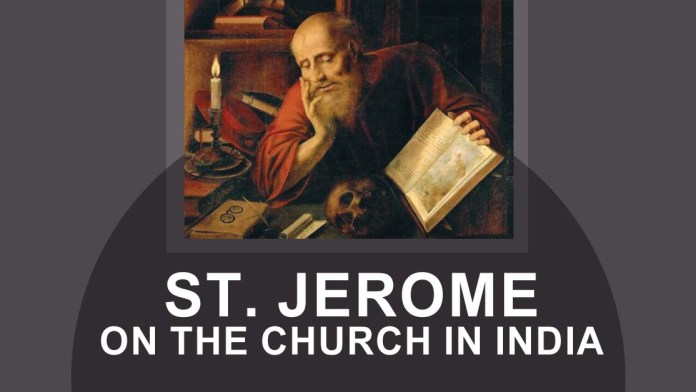
Among the great scholars of the early centuries, St. Jerome stands out as a particularly noteworthy figure. A man of profound learning, Jerome was well-versed in several languages and deeply familiar with Biblical, Classical, and Patristic literature. He also possessed substantial knowledge about the geography and natural features of India. In many of his writings, Jerome refers to the Apostle Thomas. In his work Epistola ad Marcellum, he writes that Jesus, after the Resurrection, was present simultaneously with the Apostles and angels, in the Father, and even to the ends of the sea. The risen Christ resided everywhere: in India with Thomas, in Rome with Peter, in Illyricum with Paul, in Crete with Titus, in Achaia with Andrew—He was with the apostles in every nation where they dwelled.
In his work De viris illustribus, written in 392, Jerome once again refers to St. Thomas. Writing about the apostolic ministry of Thomas, Jerome asserts that the Apostle preached the Gospel to many people, from the Parthians to the Indians. Upholding tradition, Jerome writes that the Apostle Thomas preached the Gospel of the Lord among the Parthians, Medes, Persians, Carmanians, and Hyrcanians. He further notes that Thomas died in the city of Kalamina in India. In his book Adversus Jovinum, Jerome also writes about Buddhists and Brahmins.
While Origen states that Thomas preached the Gospel in Parthia, Jerome writes that Thomas died in Kalamina. When writing about the nations evangelized by the apostles, Jerome—like Origen and Ambrose—mentions Thomas first. It is only after this that Peter is listed in connection with Rome and Paul with Illyricum. The reason for placing Thomas first in this list is not due to his rank or authority among the apostles but because he is believed to have evangelized the greatest number of nations. Because of this, Thomas is given the first place in the context of Gospel proclamation. The Church Fathers—Origen, Ambrose, Jerome, and Isidore—mention Thomas first when describing the apostolic mission, due to their clear understanding of his extensive missionary activities.
While writing about the visit of Pantaenus to India, Jerome makes another reference to India. In Epistola ad Paulinum, Jerome describes the journey of Apollonius of Tyana to India. Apollonius first arrived in Persia, then crossed mountain ranges and visited several prosperous regions of India, crossed the Ganges, and finally reached the Brahmins. In another work, Epistola ad Dardanum, Jerome writes about a traveler who, after visiting Palestine, Phoenicia, Syria, Osrhoene, Mesopotamia, and Persia, eventually reaches India. In Epistola ad Evangelium, Jerome also refers to the city of Muziris in India, where Romans at that time had come for the pepper trade.
Rev. Dr. James Puliurumbil
