



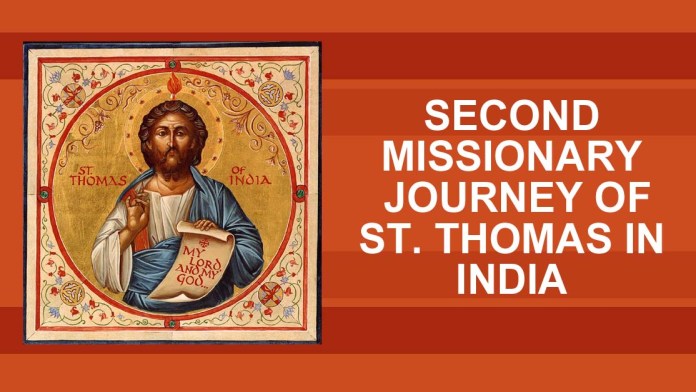
The land route connecting the Mediterranean world and the Eastern world (India and China) starts from the Roman capital. From Rome it comes to Antioch (capital of eastern Roman Empire) in Syria, and then passing through Edessa, reaches the twin city of Selucia-Ctesiphon. Selucia is a Greek city and Ctesiphon a Parthian city on the banks of the river Euphrates. Edessa, one of the small states lying in between the warring empires of Rome and Persia was a strategic junction of two highways. It is here the two ancient caravan routes met and crossed. One is the Silk Road running east from Antioch to the Persian border crossing Edessa and reaches India and China. The other caravan road crossed Edessa north and south from the mountains of Armenia down through Arabia to Egypt. This international road, which goes eastwards, crossing Zagros Mountains reaches the region called Media. Passing through Ecbatna, this road reaches Merv not very distant from Oxus river. From Merv, the route becomes two; one is known as the Silk-route, going to central Asia, while the other branch turns towards India. According to the recent study and research, St Thomas who first reached Broach (Bharuch or Barygaza) in Gujarat, a great trade centre of India, passing through Ujjain and Mathura must have also been to Taxila, the capital of the Parthian kingdom where too he preached Gospel and established Christian communities. He worked there till 48 AD when the Kushan dynasty overran and destroyed the Indo-Parthian Kingdom. Thomas must have preached gospel in many cities of North India. After the destruction of the city of Taxila he went back either to Palestine and made a second voyage to India in 52 AD.
Kerala was visited by travellers and traders from ancient times. Ancient Kerala was famous for her spices and it is her fame as the ‘land of spices’ that brought peoples and cultures to her shores even from the third millennium BC, if not earlier. Phoenicians, Romans, Greeks, Arabs and Jews had all trade contacts with Kerala. Spices were taken to the Mediterranean world using different trade routes and were widely used in the different countries of the Mediterranean. That is the reason why pepper is called ‘yavanapriya’ (dear to the Greeks/Europeans). A number of early foreign writers point to the kingdom of Male or Malabar and its trade relations with foreign countries. Herodotus (484-413 BC) gives good description of trade with India. Megasthenes (306-289 BC), the Greek ambassador of the king Selucius Nicator at the court of Chandragupta writes in his description of ancient India about the rulers of Malabar or of the Cheras.
The author of the Periplus of the Erythrean Sea is of the opinion that Muziris and Barace (Purakad) were the chief ports of Kerala from where a great quantity of pepper, the chief product of Malabar was sent to Europe. Pepper was in great demand in Rome. Pliny writs about this pepper trade of the first century AD. This vigorous trade in pepper and other spices of India began to drain the Roman empire of its wealth. He writes that both pepper and ginger grow wild in their respective countries and yet here we buy them by weight like gold and silver. This Indo-Roman contact resulted in the flow of money from Rome into the ports of India. The great number of Roman coins discovered in different parts of India including South attests to this fact. The final chapters of the Acts of Thomas close with the apostle’s journey overland into other parts of India. He appoints a deacon to preach Jesus and take his place in the land of king Gundaphar (Chapter 7, paragraph 3). Thomas then went to another kingdom (of Mazdai) in India and there preached the gospel. There again the apostle’s radical, ascetic teaching against marriage brought trouble. Some of the chief women of the kingdom including the queen are converted. The king becomes angry and accuses Thomas of bewitching them and orders his execution. He is led to a mountain outside the city where he was speared to death while praying. Thus Thomas’ mission in India was sealed with the crown of his martyrdom in India in the city of Mylapore/Chennai.
Rev. Dr. James Puliurumbil
