



“Your mother was like a vine planted by the waters; it was fruitful and full of branches because of abundant water.” (Ezekiel 19:10)
Our Mother Church can be compared to a vine that bears abundant fruit. These fruits are of two kinds. The first and most important are spiritual fruits. The holy sacraments and the divine grace received through them are the spiritual fruits that the Church, as a mother, bestows upon her children. At the same time, this vine also produces material fruits. These are offered not only to her own children but to the whole world. Dispelling the darkness of the world with the light of education, embracing orphans, the destitute, and the differently abled, and providing shelter and healthcare are clear expressions of the Church’s material fruits.
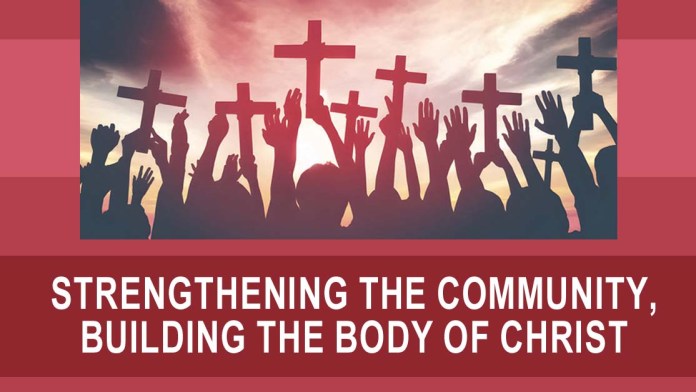
The Church bears spiritual fruit through the spiritual nourishment she receives from the Lord. At the same time, material elements such as the ministers who administer the sacraments (priests), those who receive them (the People of God), and the places where they are celebrated (churches) are also necessary for spiritual fruitfulness. Likewise, although the Church produces material fruits through the inspiration of the Word of God and the Holy Spirit, this too requires many supporting material factors. The numerical strength of the faithful, their economic condition, and their influence in society and in the administration of the State are examples of such material factors. It is precisely to reflect on these essential material elements for the spiritual and material fruitfulness of the Church, to address their weaknesses, and to strengthen them that we observe Community Empowerment – 2026.
Some raise the question: why use the term “community”? Would it not suffice to use the term “Church”? However, the word “community” is deliberately used to indicate a distinct perspective. When we speak of the Church, what generally comes to mind is the spiritual dimension: churches, sacraments, priests, and religious. But when we use the word community, our perspective naturally shifts. Our thoughts turn to our culture, traditions, customs, population, employment, economic life, and political and administrative participation—our concrete, material realities.
The word “Church” points to the profound spiritual meaning of faith, sacramental life, and divine mission. The use of the term “community” does not deny this spiritual reality of the Church; rather, it brings it into the wider realm of human relationships, participation, and responsibility. Community highlights unity, mutual dependence, and shared life among believers. It helps us recognize the Church not merely as an institution or a set of rituals, but as a living fellowship of people-a faith community that bears witness in everyday life. Thus, the term “Church” is not diminished; instead, the term “community” becomes relevant to express clearly the social and relational dimension of the Church.
In earlier times, the word “caste” was commonly used, which gave rise to notions of hierarchy and inequality. With the spread of Western education, the growth of the Indian national movement, and the influence of social reform movements, ideas of social justice and equality gained ground. Communities began to see themselves not in terms of caste hierarchy but as communities aiming at unity, mutual love, and the upliftment of their members. In this sense, the term “community” can be understood as a progressive concept.
Some mistakenly equate community consciousness with communalism. This is not correct. Community consciousness is a sense of belonging and self-respect. It is the awareness that one should love and take pride in what is one’s own—one’s people, culture, traditions, and customs. Community consciousness is entirely different from communalism, which arises from narrow-mindedness, jealousy, and the desire to harm others. Community consciousness must be understood as Christian fraternity. We know that the early Christian community was of one heart and one soul, loving one another deeply. This spirit of fraternity must grow ever more strongly among us as well.
The relationship between the Church and the community is like that between soul and body. The body is the physical dwelling of the soul. The community forms the material environment of the Church. If the Church is a vine that bears abundant fruit for the good of all humanity, the community reminds us of the vine’s self-nourishment and inner strengthening. Both together form a complete whole. In Catholic life, the spiritual and material dimensions do not move along separate paths; rather, the Church seeks their integration. Community empowerment within the Church conveys this message of wholeness. Let us love our Church and our community, strengthen them, and help them grow. May Community Empowerment – 2026 become an effective instrument for this purpose.
Archbishop Mar Andrews Thazhath
