



The root cause of most ecclesial crises lies in the fact that the Church’s self-understanding is often neither properly grasped nor correctly interpreted-both within theological circles and in ordinary discourse. The way one understands the Church determines how one relates to her and presents matters concerning her. Those who see the Church as a political system will treat her politically; those who regard her as a social institution will confine her to social service. Likewise, some consider the Church as a revolutionary movement, a club, or a mere organization. This stems from a lack of true understanding. But what, in essence, is the Church-according to the Church herself?
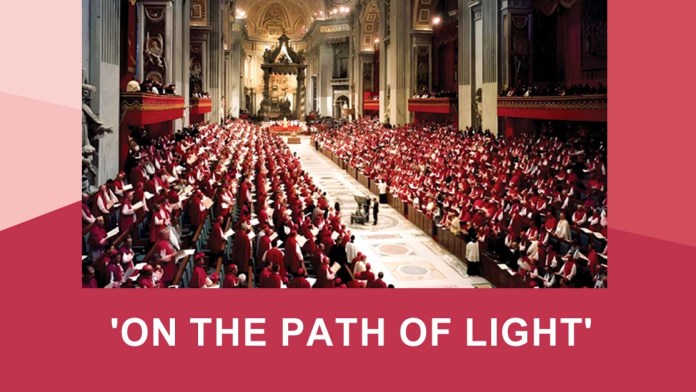
In the Church’s vision, the teachings of the Synods are always given primacy over theological speculations. Synods have generally spoken to the Church and to the world on matters of faith. However, the Second Vatican Council turned its attention to speak specifically about the Church herself. The Church’s own self-awareness-what she understands herself to be-is presented in the Dogmatic Constitution on the Church, Lumen Gentium.
The Second Vatican Council, in speaking about the Church, employs three principal terms: Mystery, People of God, and Body of Christ. Let us examine the meaning and significance of these terms as the Council teaches them.
People of God
The expression People of God is perhaps the most misunderstood term in the discussions of the Second Vatican Council. It is often said that “the Council teaches that the Church is the People of God.” Yet, surprisingly, the Council’s references to the “People of God” do not refer to the Church in the sense many understand it today.
In truth, the expression People of God is an Old Testament concept. It refers to Israel, the people whom God chose as His own. They were a community brought together and fashioned by God Himself-a people with whom He journeyed for forty years in the desert, made a covenant, gave the Law, and formed into a community of obedience and identity.
The New Testament does not call the Church “the People of God.” The Council uses the expression only in a broad, analogical sense, to indicate that the Church is the continuation of God’s salvific plan for His people begun in Israel. It also uses the term to highlight the Church’s human and communal dimension and to express her relationship with other human communities. But wherever the term people is overemphasized, the divine authority tends to be forgotten, and the Church risks being interpreted through the lens of democracy, as though she were ruled by popular sovereignty. Yet, the Church’s order of life is not the dominion of the people but the dominion of God. Thus, the term People of God has sometimes been misused as a tool for excessive individualism, social revolution, and even anti-clerical attitudes.
The Church of Mystery
If the Church is not merely the People of God, then what is she? The Church humbly acknowledges herself to be, beyond a human community, a divine and heavenly mystery. She is hidden from human understanding and can be revealed only through the Holy Spirit. The Church is not a system “constructed” or “controlled” by us.
The visible structures and institutions, the gatherings of people, are only the visible elements of the Church. But the true reality of the Church transcends these visible components. The Church comprises together the faithful in heaven, purgatory, and on earth. Among these, the heavenly members hold primacy, for they have attained the fullness of the life of Christ. Therefore, the Church should not be regarded merely as an earthly organization of believers. Her identity is modeled upon and oriented toward the heavenly Church.
That is why the Council, in its very first chapter, speaks of the mystical nature of the Church. The Holy Church is the sacrament through which Christ becomes present on earth. The Church is governed not by worldly systems but by the Holy Spirit who operates within her. This understanding enables us to grasp that the Church is indeed a mystery beyond human reasoning.
The truth that “the Church is the Kingdom of God on earth” must be understood in relation to this mystical nature. The Lord Jesus said to His apostles, “The Kingdom of God is among you.” The Church makes the heavenly Kingdom present within the confines of this temporal world-a profound and unfathomable mystery.
The Body of Christ
What, then, is the Church in her deepest reality? The Council’s answer is clear: the Church is the Body of Christ. This is not a new discovery but a truth constantly affirmed in Sacred Scripture and in the teachings of the Church Fathers. Through the holy Baptism, Christ unites us to His risen Body and thus constitutes the Church. Christ is the Head of this Body, and we are its members.
In the Old Testament, the People of God (Israel) were bound together as members of a community. In the Church, however, the unity is more intimate-it is the relationship among members within a living body. This makes the Church unlike any other form of human association. Her uniqueness lies precisely in being the Body of Christ.
The Church’s mystery is rooted in this reality: she is the Body of Christ. Just as the Holy Eucharist contains both visible and invisible realities, so too does the Church. In both, the invisible reality is the divine Person of Christ Himself. Whoever fails to perceive that the Church is Christ Himself neither truly knows nor loves the Church. The Church is not merely a religion, a community of faith, or a people; she is the indwelling of humanity in the Body of Christ. This truth must be continually remembered and taught.
Therefore, it is Christ Himself, not the gathered community, who offers true worship to the Father. We participate in His sacrifice as members of His Body. If the Church is understood merely as the People of God, the Eucharist and divine worship lose their true meaning. To grasp the Second Vatican Council’s vision of the Church correctly, these insights are indispensable.
Theological Perspectives
Catholic theology speaks about the Church upon certain firm foundations: Sacred Scripture, the writings of the Fathers, the teachings of the Councils, and Trinitarian theology as correctly interpreted by the great theologians. Some interpret these sources liberally, others conservatively. Let us briefly consider a few major theological perspectives on the Church.
Communion Ecclesiology
Among contemporary ecclesiological visions, Communion Ecclesiology holds a place of great importance. One of the central insights of the Second Vatican Council is the concept of Communion (Koinonia). Prominent theologians such as Joseph Ratzinger, Henri de Lubac, and Yves Congar made major contributions to this perspective. The understanding that the Church’s very inner nature is communion, and that she is founded upon the Eucharist-the sacrament of unity-has brought about deep renewal in ecclesial life.
The Church recognizes that every particular Church (Eparchy or Archeparchy) possesses equal dignity and importance, and that their communion constitutes the very existence of the Church. Ratzinger wrote, “To receive the Eucharist is to receive the communion of the Church.” Congar likewise stated, “The Church is not primarily an institution or an organization; rather, it is a communion of life in faith, hope, and love in Christ and in the Holy Spirit-a participation in divine fellowship.”
The Church as Sacrament of Salvation
A sacrament is a visible sign of invisible grace. The Church herself is the supreme sacrament-making God’s saving grace visible in the world. Christ dwells in His Body, the Church, and through her becomes the sign of salvation for humanity. The French theologian Henri de Lubac powerfully reintroduced the notion of “the Church as sacrament” into modern theology, influencing the Council’s documents. Karl Rahner described the Church as the fundamental sacrament of divine grace. “God becomes visible to humanity in history through the Church,” he wrote. Hence, the Church is the social form of divine grace, and the individual sacraments are its specific expressions.
The Pilgrim Church
A profoundly meaningful image of the Church is that of a pilgrim people journeying toward eternity. The Church is on her way to the Kingdom of God-bearing witness in history but finding her fulfillment in eternity. Christ leads her on this journey, the Spirit empowers her, and her goal is communion with God. As Ratzinger wrote, “The Church has no permanent dwelling on earth; she is always a pilgrim journeying toward God.”
Models of the Church
Avery Dulles proposed the concept of “Models of the Church” to understand the complex reality of the Church from different perspectives. Including those discussed above, there are six models:
1. The Institutional Model: The Church as the visible society founded by Christ, possessing a hierarchical structure of authority. 2. The Mystical Communion Model: The Church as a spiritual community united by faith, love, and grace in the Holy Spirit.3. The Sacramental Model: The Church as the visible sign of invisible grace. 4. The Herald Model: The Church as the proclaimer of the Word of God, emphasizing her mission of evangelization. 5. The Servant Model: The Church as the servant of humanity, a symbol of social justice and charity. 6. The Community of Disciples Model: The Church as a community of disciples following Christ.
According to Dulles, the divine mystery of the Church cannot be fully captured by any single model. Only through the integration of all these perspectives can the mystery of the Church be more fully revealed. This, indeed, underscores the richness and necessity of viewing ecclesiology from multiple angles.
Rev. Dr. Arun Kalamattom
