


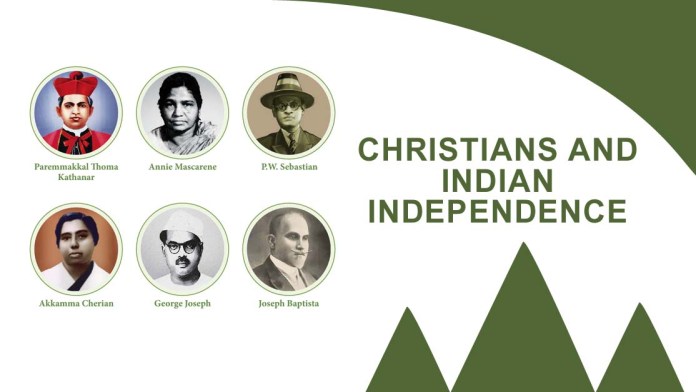
Paremmakkal Thoma Kathanar
The author of Varthamanapusthakam, the first travelogue in Malayalam, was a nationalist who, as early as the eighteenth century, declared that India belonged to Indians and should be governed by them. He introduced the word “quarantine” to Malayalam and was a zealous advocate for the reunification of the Christian community. A historian of renown and a man of action, Thoma Kathanar was born on 10 September 1736 in Kadanad village of Meenachil taluk, Kottayam district, to Paremmakkal Kuruvila and Annamma. He served as the Governor of the Syrian Catholics and passed away on 20 March 1799. His tomb is located at the new church in Ramapuram.
Annie Mascarene
Known as the “Heroine of Travancore,” she was a trailblazing freedom fighter. A founding leader of the Travancore State Congress, she was the first woman on its working committee, a member of the Travancore-Cochin Legislative Assembly, the first woman from the capital to be elected to the first Lok Sabha as an independent, the first woman minister of Kerala, and the first woman to resign from the cabinet. She was also a signatory to the draft Constitution of India. Born on 6 June 1902 to Gabriel, a clerk in the Travancore administration, and Mary. While practicing law at the Vanchiyoor Court, she joined the State Congress. Arrested on 26 April 1938 for participating in the Non-Cooperation Movement, she also played a key role in the Quit India Movement and was arrested again on 30 August 1942. After two years of rigorous imprisonment, she became secretary of the State Congress and participated in the Udaipur session of the All India State Congress. Annie was later elected unopposed to the Constituent Assembly of India. She passed away on 19 July 1963.
P.W. Sebastian
A freedom fighter from Thrissur, he joined Mahatma Gandhi in the independence movement. Born on 26 December 1890 in the Poovathinkal family at East Bazaar, Thrissur, he was inspired by Motilal Nehru while in Bombay. In 1921, he was the only Malayali to take part in Gandhi’s foreign cloth boycott at Parle, Mumbai. He initiated this movement in Thrissur and published the newspaper Lokamanyan. He was a principal organizer of the Vaikom Satyagraha and when Gandhi visited Thrissur in 1927, it was Sebastian who brought him a palm-leaf umbrella. He authored works such as Khilafat, Jallianwala Bagh, and Swaraj. Though largely forgotten by official histories, this unsung hero lies buried in the cemetery of Kuriachira Church, Thrissur.
Akkamma Cherian
Hailed by Mahatma Gandhi as the “Jhansi Rani of Travancore,” she was a valiant freedom fighter. Born on 12 February 1909 in Kanjirapally, Kottayam, to Thomman Cherian of Karippaparampil and Annamma of Punnakkudiyil, she stepped into the freedom struggle when the Travancore State Congress launched an agitation against the misrule of Dewan C.P. Ramaswamy Iyer. Accamma led a massive procession to the royal palace, and she was imprisoned multiple times for her activism. She passed away on 5 May 1982.
Bhaje Bharatam Mathunny
A Christian fighter who made an indelible mark on the freedom movement in Travancore, he was born in 1898 in Ullannur, Kulanada, Pathanamthitta. He played a pivotal role in organizing the first All Travancore session of the Indian National Congress held in 1922 at Chengannur. Actively involved in the Vaikom Satyagraha, he founded the newspaper Bhaje Bharatam, whose fiery editorials kindled patriotic fervor and criticized the British administration and Travancore’s Dewan. The government banned the publication, confiscated the press, and fined and imprisoned Mathunny. Upon his release, he had lost both his press and property. He died on 17 April 1937 and is buried at the Orthodox Church cemetery in Ullannur.
S.K. George
Inspired by Gandhian ideals, he became an ardent follower and interpreter of Gandhian philosophy. Born on 10 March 1900 in Kottayam to Thommi Kuruvila and Eliya of Srampickal, he was convinced that it was a historical duty of Christians in India to stand with the national movement. In 1932, he published India in Travail in the Amrita Bazar Patrika, calling upon all Christians to join the civil disobedience movement. His major works include Gandhi’s Challenge to Christianity and The Life and Message of Jesus Christ. He passed away on 4 May 1960.
Samuel Aaron
Born on 13 March 1894 in Ezhimala, Kannur, he was a leader of the nationalist movement in Malabar. He upheld Gandhian ideals, took part in civil disobedience, endured police brutality, and served multiple prison terms. He organized receptions and accommodations for participants of the Salt Satyagraha in Payyannur and raised funds to support the cause. He died in 1975.
George Joseph
A towering figure in India’s national politics, he was a lawyer, journalist, and Gandhi’s close disciple. Born in Chengannur on 5 June 1887, he was a prominent leader of the Vaikom Satyagraha and a key strategist in the temple entry movement. He vocally opposed the anti-Christian policies of Dewan C.P. Ramaswamy Iyer. George Joseph was active in the Home Rule Movement and took part in many protests in Travancore. He passed away at the age of fifty on 5 March 1938.
Fr. Cyriac Vettikappally
A Catholic priest who participated in the Vaikom Satyagraha and shared a stage with Mahatma Gandhi. Born on 2 February 1878 in Vaikom to Kuruvila and Maria, he was elected to the Travancore Legislative Council in 1922. In 1924, he joined a delegation that submitted a petition to the Regent Maharani advocating for Christian minority rights. On 17 March 1925, under his leadership, several priests visited the Satyagraha Ashram and expressed support for the movement. Though Gandhi maintained that non-Hindus should not take direct part, Fr. Vettikappally played a leadership role as a Council member. He passed away on 27 February 1947. His photo and name are displayed at the Vaikom Satyagraha Memorial Museum.
Titus Theverthundiyil
The only Christian participant in the Dandi March, he was born on 18 February 1905 in Chirayiramp, Maramon, Pathanamthitta, to T.K. Titus and Eliyamma. He and his wife Annamma moved to Sabarmati Ashram and became active in khadi promotion. Annamma donated all her jewelry to Gandhi. Titus took part in the Dharasana Salt Satyagraha, where British police assaulted peaceful protesters. After independence, he settled in Bhopal and died on 8 August 1980.
Joseph Baptista
Born on 17 March 1864 in Bombay, he was a lawyer and early nationalist. He was the first to declare the now-iconic slogan “Swaraj is my birthright and I shall have it,” later made famous by Bal Gangadhar Tilak. He was a founding member of the Home Rule Movement along with Tilak and Annie Besant. He died on 18 September 1930.
K.T. Paul
Kanakarayan Thiruselvam Paul, born on 24 March 1876 in Salem, was a leading Christian freedom fighter and president of the All India Conference of Indian Christians. He represented Indian Christians at the First Round Table Conference in London in 1930 and served as national general secretary of the YMCA. He passed away on 11 April 1931.
There are hundreds of other Christians who made invaluable contributions to India’s freedom movement. Some notable names include “Utkal Gaurav” Madhusudan Das, Venkat Chakkara, Brahm Bandhav Upadhyay, Neeraj Vishwas, Kali Charan Banerjee, and Harendra Mukherjee.
The involvement and advancement of Christians in India’s freedom struggle are often overlooked or underrepresented. One may rightly suspect deliberate attempts to obscure or suppress this part of history. Yet, the greatest truth is that no matter how much the truth is trampled upon, it cannot be hidden forever. The lives briefly sketched above are living witnesses to this truth. Let us, therefore, remember these forebears-alongside all the fearless patriots who fought for freedom-with respect, gratitude, and love.
