


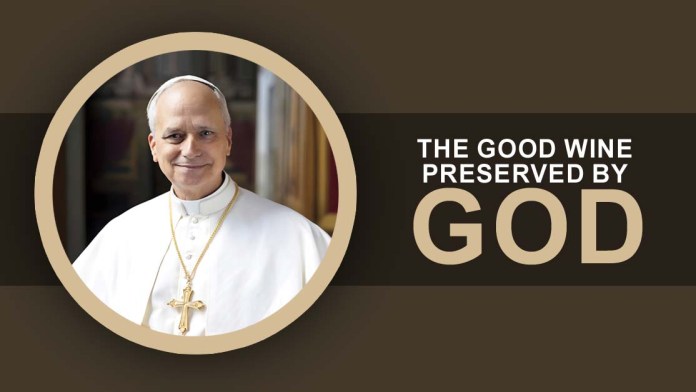
On the 8th of May, 2025, when the name “Cardinal Robert Francis Prevost” was announced from the balcony of the historic St. Peter’s Basilica as the 267th Pope of the Universal Church, the world must have paused in astonishment. For here was a man who had not featured in long-standing media analyses or in the meticulous predictions of Vatican experts. Even though he had held the crucial responsibility of leading the Roman Dicastery for Bishops, his name had remained largely unnoticed. How did the world overlook such a person? It is indeed surprising. Yet, that is often how God works—hiding the most precious treasures in plain sight with a special tenderness. The choices made in the divine ministries are always a manifestation of God’s boundless freedom. As the Bible says, “The wind blows wherever it pleases; you hear its sound, but you cannot tell where it comes from or where it is going.” In his first appearance on the balcony of St. Peter’s Basilica, Pope Leo XIV’s simple smile, quiet confidence, and expression of faith in both God and humanity reflected three central principles of Pope Leo XIII’s pontificate.
It was Shakespeare who famously asked, “What’s in a name?” But indeed, names matter. The Latin name Leo finds its roots in the Greek LEWN- Leon, meaning lion. Thirteen popes in Church history have borne this name, starting with the great Leo I, who heroically persuaded the fierce and destructive Attila the Hun to spare Rome. The name Leo XIV, therefore, carries with it a powerful symbolic message. Church historians often assert that the era of modern papacy begins with Leo XIII, who led the Universal Church from 1878 to 1903. He was a reformer who modernized the Church, redirected her attention to the contemporary world, awakened a sense of social responsibility within her, envisioned a society grounded in justice, and opened new doors for theology and biblical studies. By choosing the name Leo XIV, Cardinal Robert Francis Prevost signals a continuity with this legacy. Known as “Padre Prevost” during his missionary years in the slum-like outskirts of Trujillo, Peru—a region bloodstained by internal conflicts—Pope Leo XIV brings the promise of advocacy for justice and a solidarity with the marginalized as central themes of his pontificate.
In his first address from the Basilica of St. Peter, Pope Leo XIV expressed two key priorities of his pontificate. The very first words he uttered were: “Pace a voi” — “Peace be with you.” To a world weary and traumatized by war stories, what else can be expected from the Vicar of Chr ist? The Church must be a messenger of peace, and her children must be peacemakers. Just like the heroic Leo I, may Leo XIV have the courage to stand fearlessly before the powers that be and lead them on the path of peace! In his inaugural message, the Pope called us to be a Church that builds bridges — extending hands of help, presence, love, and dialogue to those in need. He urged us to become a Church of encounter and conversation. His chosen motto, “In illo uno unum” — “That all may be one in Christ” — reflects a hope that he might guide our conflict-ridden world to peaceful shores and heal the wounds of division.
Another prominent theme in Pope Leo XIV’s early messages is a renewed missionary zeal that is expected to characterize his papacy. He declares in his first statement: “The world longs deeply for the light of Christ.” In his homily during his first papal Mass, he affirms, “Our vocation is to bear joyful witness to our faith in Christ.” Quoting the famous line of St. Ignatius of Antioch, he adds, “It is not I who live, but Christ who lives in me. I disappear so that Christ may be made visible. I allow myself to be consumed so that Christ may be known and loved by all” It is hoped that Pope Leo XIV will address the missionary inertia that has marked the modern Church. As the saying goes, “The real remedy for a sick Church is to put it on a missionary diet.” There is indeed great hope that he will introduce such a transformative missionary vigor to revive the contemporary Church, which often suffers from spiritual lethargy.
Among the 24 particular Churches that make up the Catholic Church, 23 are Eastern Churches. Pope Leo XIV’s words reveal a deep openness toward the Eastern Churches and a genuine respect for the spiritual heritage of the East. One of the first public events he attended after becoming Pope was the jubilee celebration of the Eastern Catholic Churches. Addressing them, he said, “The Church needs you. With your ancient spiritual traditions, you can renew the spirituality of the Universal Church.” Just as Pope Leo XIII boldly presented the grandeur of Eastern Christianity before the West through his encyclical Orientalium Dignitas (“The Dignity of the East”), we can hope that Pope Leo XIV will show even greater openness toward the needs and dignity of Eastern Christians.
“You have kept the good wine until now”—this famous Biblical phrase encapsulates the mystery of divine timing. God always reserves the best for the right moment. In a single phrase, Pope Leo XIV—Robert Francis Prevost—can be described as the “good wine” that God has preserved, unnoticed by the world, for the sake of our times, both for the Church and for the world. What else can we call the divine justice that lifted a man bearing the scent of common humanity, with tears and trials etched into his story, from the slums to the throne of Peter, but a sheer marvel?
Rev. Dr. Tom Olikkarott
