



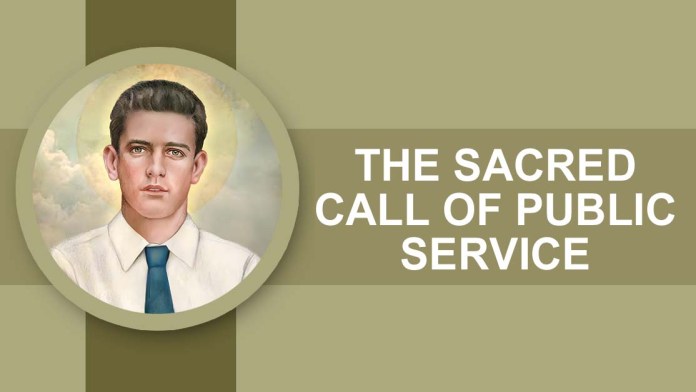
Alberto sat at the dinner table with his mother nearby. As they ate, his mother noticed a beggar standing in their courtyard. Without hesitation, she took a portion of food from Alberto’s plate and gave it to the poor man. While doing so, she said to her son, “Christ has come to us, and He is hungry too.” This simple act of compassion left a lasting impression on young Alberto, sparking a lifelong dedication to serving the poor and vulnerable.
Born on March 21, 1918, in Italy, Alberto was the second of six children of Luigi Marvelli and Maria. The family faced a severe crisis when Luigi passed away in March 1933. Despite these challenges, Alberto grew up deeply rooted in Christian virtues. His daily life revolved around morning prayers, personal devotions, spiritual reading, attending Mass, and receiving Holy Communion.
Later, in Turin, he became the president of the Catholic Action Lay Apostolate. After earning an engineering degree from Bologna University, Alberto worked at Fiat in Turin. However, it was during the tumultuous years of World War II that his extraordinary gifts and virtues came to light.
Forced to flee his homeland with his family during the war, Alberto nonetheless returned to his hometown daily to care for the sick and provide for the needy. Whether it was food, clothing, or medicine, Alberto ensured that those in need received essential supplies. He also saved many people from Nazi prisons during this time.
After the war, Alberto was appointed an administrator of the Town Council. Demonstrating his commitment to public service, he established a soup kitchen to feed the poor and personally took part in distributing food. His vision extended beyond charity, as he actively worked to represent Christian values in Italian politics. Tragically, Alberto’s life was cut short in a vehicle accident on October 5, 1946, as plans were underway to formally involve him in politics.
Archbishop Angelo Comastri captured the essence of Alberto’s life in a radio address following his death: “Alberto’s life proves that one can be both a politician and a saint. He is a shining example of honesty in politics and public service.”
The process of canonizing Alberto Marvelli began on March 29, 1952, when the Congregation for the Causes of Saints granted him the title “Servant of God.” His beatification process was officially initiated under Pope Paul VI on January 16, 1975. An investigation held in Rimini from July 13, 1975, to August 17, 1976, was later validated by the Congregation in Rome on May 29, 1981. The formal dossier (Positio) was completed in 1983, and theologians approved it on October 23, 1985. Pope John Paul II declared Alberto “Venerable” on March 22, 1986, recognizing his life of heroic virtue.
A miracle attributed to Alberto involved the healing of Dr. Tito Malfatti from Bologna, who recovered from an aggressive hernia in August 1991. This miraculous healing was examined by a tribunal led by Cardinal Giacomo Biffi. On November 14, 2002, a medical panel declared that the healing had no scientific explanation. Theologians approved this finding on March 4, 2003, and the Congregation confirmed it on May 20, 2003. Pope John Paul II officially confirmed the miracle on July 7, 2003, and personally beatified Alberto on September 5, 2004, in Loreto. Over 250,000 people gathered to celebrate this momentous occasion.
Alberto Marvelli’s life continues to inspire as a testament to the union of faith, service, and integrity. He remains a powerful example of how one can transform the world through selfless love and unwavering devotion to God.
Blessed Alberto Marvelli
