



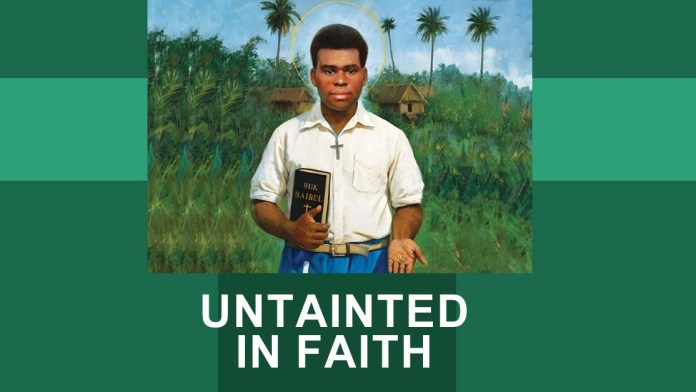
St. Peter To Rot
We see nothing until we truly behold it. We understand nothing until we truly know it. Until October 19, 2025, that name was not widely known to the world. It is of St. Peter To Rot that we speak. But on that day, when Pope Leo XIV declared Peter To Rot a saint together with six others, that life became like a lamp set upon a pedestal. A layman, a tribal, a married man, a catechist, and above all, the first saint of Papua New Guinea – these are the general descriptions of St. Peter To Rot. Yet beyond all these descriptions stands a life of astonishing holiness.
Peter’s parents were leaders among the local tribal community. But the evangelizing mission by the Missionaries of the Sacred Heart priests lit a new flame in their lives. Under the radiance of that newfound light, their lives were immersed in faith. Naturally, Peter too began to walk in the path marked out by his parents. He was born in 1912. In 1930 he joined St. Paul’s College, established by the Missionaries of the Sacred Heart, where he received formation for the work of evangelization.
Because of the scarcity of priests, catechists played the most important role in parish administration and evangelization in the remote parts of Papua New Guinea. After three years of formation, Peter was appointed as a catechist in Rakuwani parish, and on November 11, 1936, he married Paula. They were a model couple who prayed together. Until then, everything had been flowing in a normal rhythm – but by 1943, the climate had changed. The major reason was the Japanese occupation.
By then, Peter had gone to great lengths in his pastoral service – nursing the sick, visiting homes, providing catechesis, administering baptism, carrying food to imprisoned evangelizers, and training new catechists. All this became necessary because the Japanese army had invaded Papua New Guinea and imprisoned all priests and religious. Peter’s activities greatly disturbed the Japanese soldiers. Under the pretext of wartime security, they imposed restrictions on his ministry.
By 1944, the army had completely banned him from carrying out any public ministry. But Peter responded with prudence. He built underground shelters, gathered people there, and continued to preach the Gospel in secret. He did all this fully aware that if the Japanese discovered him, his life would be in danger. At this time another moral crisis arose before Peter. The Japanese had legalized polygamy in order to win over tribal chiefs. This deeply afflicted Peter. He boldly stood up and protested against this evil.
In May 1945, Peter was arrested and imprisoned by the German military. When his release was near, two Japanese soldiers, with the assistance of an army doctor, injected him with poison and killed him. The Japanese army informed his relatives that Peter had died of illness. But when his uncle arrived, he found Peter’s body with an injection mark on the right hand, with cotton stuffed in his ears and nose, and his scarf soaked in blood around his neck. When his wife had once pleaded with him to give up catechetical ministry if he wished to live, Peter replied that such a thing was impossible for him. When his mother visited him in prison, Peter said: “The police have informed me that this evening a Japanese doctor will come to give me some medicine. Since I am not ill, I believe there is some deception behind this.” And so, he dressed himself in his best clothes and wore a crucifix, prepared to stand before God.
