



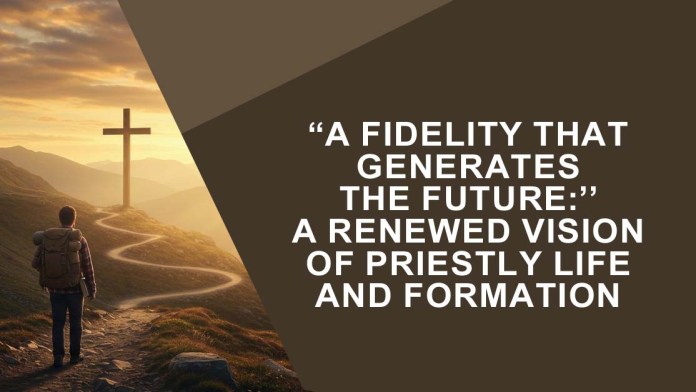
The Apostolic Letter “A Fidelity that Generates the Future” issued on December 8, 2025, by Pope Leo XIV for the Universal Church is a prophetic voice that redefines priestly ministry in the contemporary world. Promulgated on the diamond jubilee of the Second Vatican Council, this Apostolic Letter serves as a guiding light for priests to deepen their vocation and mission in the modern age. The document affirms that the future of the Church and of the priesthood is grounded in priestly fidelity.
The Holy Father underlines the truth that the renewal of the Church depends on the spiritual renewal of priests. Both priestly formation and priestly life are explained and evaluated on the basis of the value of fidelity. Fidelity is not a static condition; rather, it is a creative dynamism that generates the future. It is a continuous journey sustained by divine grace and ongoing conversion.
1. Fidelity and Ministry
The priestly vocation begins with a personal encounter with Christ. The question addressed to Peter on the shore of the Sea of Galilee—“Do you love me?”—must be faced daily by every priest. One must never forget that before being a shepherd, a priest is first a disciple of Christ. Priestly formation does not end in the seminary; it is a lifelong process of human, spiritual, and intellectual renewal. Seminary formation is not merely academic training, but a school of learning to love like Jesus. A priest is called to be a bridge leading people to Christ, and for this, both human maturity and spiritual strength must harmoniously converge.
2. Fidelity and Fraternity
Priestly fraternity is not merely friendship, but a unique gift received through the Sacrament of Holy Orders. A priest participates in two forms of fraternity: firstly, the fraternity with all the faithful through Baptism, and secondly, the sacramental fraternity with the bishop and fellow priests. The Holy Father identifies individualism as a serious threat to fraternity. There is no place for individualism in Christian ministry. Mutual love and cooperation among priests enhance the credibility of the proclamation of the Gospel.
3. Fidelity and Synodality
Priests are called to move from an authoritarian style of leadership to a synodal style of participation. Recognizing the charisms of the laity and involving them in the mission of the Church not only lightens the burden of priestly ministry but also renders it more fruitful. The priest is configured to Christ not to exercise domination over others, but to serve. Ecclesial ministries must move away from a model centered on one individual toward a more inclusive and participatory approach.
4. Fidelity and Mission
A priest who becomes self-centered loses missionary zeal. It is in self-giving for the people that a priest discovers his true identity. Without falling into the trap of mere efficiency or becoming passive, he must proclaim the Gospel, animated by pastoral charity. Through a life of simplicity and humility, priests are called to bear authentic witness to Christ.
Conclusion: Fidelity and the Future
The Holy Father calls for addressing the decline in priestly vocations and for facing the future with hope. Rather than succumbing to fear over the scarcity of vocations, the Church must pray for a new Pentecost. Priests must courageously present the radical demands of the Gospel to the youth. Like John Mary Vianney, priests are called to offer themselves as the love of the Heart of Christ, thereby making the future of the Church radiant with hope.
Rev. Dr. Roby Koonthaniyil
