



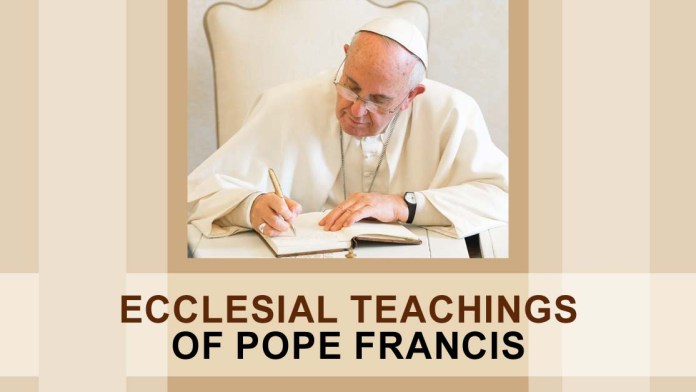
Pope Francis has consistently demonstrated a distinctly pastoral approach in his teachings. Moving away from the typical mode of instruction that relies heavily on definitions, theological frameworks, and formal presentations, he has succeeded in offering ecclesial teachings in a practical and accessible manner. His reflections are not analytical dissertations in the academic sense, but rather, he perceives and communicates ecclesial matters through the eyes of a shepherd. This article presents a concise summary of the encyclicals and apostolic exhortations of Pope Francis.
1. Encyclicals
Pope Francis has authored four encyclicals:
1.1. Lumen Fidei (“The Light of Faith”)
This first encyclical of Pope Francis was published on July 5, 2013, during the Year of Faith observed by the Universal Church. The initial draft was completed by Pope Benedict XVI before his resignation. Pope Francis adopted the text, adding his own insights to complete the document. It contains four chapters and centers on the theme: Faith is Light. This light illuminates the human heart and touches every sphere of human existence. It is a divine light that does not originate from us, but from God. We are merely instruments, with God being the ultimate actor.
1.2. Laudato Si (“Praise Be to You”)
Published on June 18, 2015, this encyclical addresses environmental issues. Inspired by the ecological vision of St. Francis of Assisi, it spans six chapters and outlines the challenges our common home—the Earth—faces, the root causes of these crises, and practical responses. Among the challenges are pollution, climate change, water scarcity, loss of biodiversity, declining quality of human life, and global inequalities. Though technology has advanced civilization, some interpret science as a license to exploit nature for consumption or as a disposable commodity. The encyclical asserts that nature should not be viewed as separate from us or merely as our habitat—we are an integral part of it.
1.3. Fratelli Tutti (“All Brothers”)
This encyclical was released on October 4, 2020, drawing inspiration from St. Francis of Assisi’s vision of universal fraternity. Through its eight chapters, Pope Francis advocates a vision of global human fraternity. Topics include social, political, and economic responsibilities toward one another as children of God and brothers and sisters; the inherent dignity and equality of all people; preferential concern for the poor; community; peace-building; and environmental stewardship. The encyclical laments the growing disregard for the dignity and worth of individuals, particularly the poor and differently abled. While human rights are theoretically accepted, exploitation and elimination of individuals for vested interests persist. Despite claims of poverty eradication, economic inequality has worsened, and basic necessities remain inaccessible for many. Pope Francis reminds us to see Christ in the neglected and wounded.
1.4. Dilexit Nos (“He Loved Us”)
Published on October 24, 2024, this encyclical focuses on the Sacred Heart of Jesus, especially His human and divine love. It commemorates the 350th anniversary of Jesus’ apparitions to St. Margaret Mary Alacoque, the apostle of devotion to the Sacred Heart. Comprising five chapters, the encyclical presents God as compassionate and near—revealed through Jesus’ words and actions. Jesus paid attentive care to individuals and their needs. True devotion to His Sacred Heart should guide us to love God and our brothers and sisters. Among the noblest acts of reciprocating Christ’s love is to love others with sincerity.
2. Apostolic Exhortations
Pope Francis has issued seven apostolic exhortations:
2.1. Evangelii Gaudium (“The Joy of the Gospel”)
Issued on November 24, 2013, this exhortation discusses evangelization in the modern world. It reflects on the Synod held in Rome from October 7–28, 2012, which focused on the transmission of the Christian faith and new evangelization. In five chapters, the Pope elaborates on the Church’s missionary role and social dimension. It explores the joy of sharing the Gospel and the joy of Christian life. Pope Francis highlights the challenges and distinct characteristics of evangelizing in today’s context.
2.2. Amoris Laetitia (“The Joy of Love”)
Published on April 8, 2016, this exhortation builds upon the two Synods on the family held in 2014 and 2015, integrating their insights with Pope Francis’ own teachings. Spread across nine chapters, the document views the family as a unit of interconnected relationships and community. The Church is the family of families. Supporting family life is a core duty of the Church.
2.3. Gaudete et Exsultate (“Rejoice and Be Glad”)
Released on March 19, 2018, this exhortation emphasizes the call to holiness. It should be read in the context of Evangelii Gaudium. Through five chapters, the Pope reflects on the inseparable link between holiness and joy. The gift of holiness is abundantly poured out by the Holy Spirit upon all the faithful. Besides canonized saints and martyrs, many live holy lives among us—our parents, siblings, clergy, and religious. Each person must strive toward holiness according to their own state in life.
2.4. Christus Vivit (“Christ Lives”)
Addressed to young people, this exhortation begins with the affirmation: “Christ lives; He is our hope.” It emerged from the Youth Synod held from October 3–28, 2018, in the Vatican. Comprising nine chapters, the document addresses how today’s youth often fall prey to ideological manipulations or the schemes of political and economic powers. Pope Francis assures that God loves young people and urges the Church to walk with them as a supportive community.
2.5. Querida Amazonia (“Beloved Amazonia”)
Published on February 12, 2020, this four-chapter exhortation draws on the Synod held from October 4–27, 2019, focused on new paths for the Church in the Amazon and integral ecology. It reflects the discussions and insights of bishops, indigenous representatives, and experts. The document provides a general roadmap for addressing the Amazon region’s social, ecological, pastoral, and moral challenges across nine countries.
2.6. Laudate Deum (“Praise God”)
Signed on October 4, 2023—the feast of St. Francis of Assisi—this exhortation serves as a continuation and contextual update of the 2015 encyclical Laudato Si. Its central concern is the climate crisis, which Pope Francis identifies as the greatest current threat to humanity. Divided into six parts and comprising 73 sections, it emphasizes the urgency of public awareness and our shared responsibility to preserve ecological balance in creation.
2.7. C’est la Confiance (“It Is Confidence”)
Published on October 15, 2023, this exhortation begins with the words of St. Thérèse of Lisieux: “It is confidence and nothing but confidence that must lead us to Love.” It was released in honor of the 150th anniversary of her birth, the centenary of her canonization, and in recognition of her being included by the United Nations among the most influential spiritual figures of the age. The document, spread over four chapters, encapsulates the core spirituality of St. Thérèse.
Conclusion
Beyond these encyclicals and apostolic exhortations, Pope Francis has also issued apostolic letters, motu proprios, and apostolic constitutions. Many of these documents are essential for the governance and day-to-day functioning of the Church. Through his ecclesial teachings, Pope Francis demonstrates a profound ability to engage with the contemporary world. His writings offer both spiritual insight and practical wisdom—not only for Christians but for people of all faiths. They serve as guiding lights for our times.
Rev. Dr. Sebastian Chalackal
