


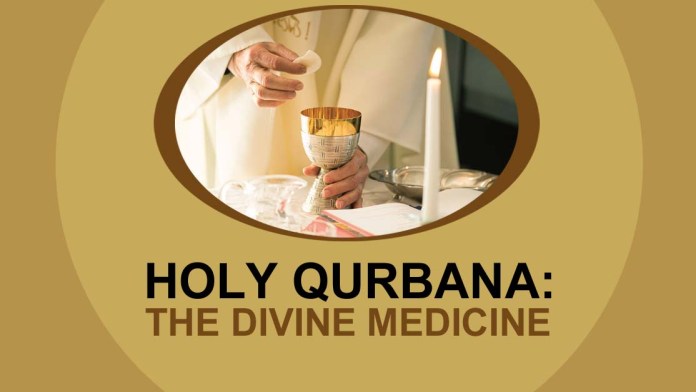
Jesus, who began his public ministry in Galilee and healed the sick in Tyre, Canaan, Caesarea Philippi, the land of the Gerasenes, Judea and Jerusalem, instituted the Holy Eucharist before his death and resurrection. After his resurrection, through the Holy Eucharist that is the result of the Holy Qurbana, Jesus continues to minister healing to the sick in his mystical body, the Church. Holy Eucharist is the divine medicine that Jesus gave to the sick.
After the sacramental words in the Holy Qurbana, the celebrant prays: “Lord, you have given us such a great blessing that we cannot express our gratitude… You have enriched us who were depraved and revived us who were dead… You have adorned our weak nature with your abundant blessings…” Then, in the intercessory prayer, the celebrant prays, “Please accept this Mass for all who are sick and troubled.”
The Holy Eucharist is the divine medicine that forgives debts and forgives sins. As a doctor in a government hospital, I remember the priests who come to give Holy Communion to the patients. I am a person who has seen the spiritual and physical comfort and healing that patients experience after receiving the Holy Communion. Pope John Paul II, who was a pro-life missionary and loved families took Holy Eucharist as his medicine and was strengthened by it in his sickness and his old age. The Holy Eucharist, with the real presence of Jesus, is an indescribable divine medicine that surpasses all medicines.
After the celebrant’s prayer, “The Holy Qurbana is for the holy people,” the worshipping community proclaims their faith in the Lenten Eucharistic Hymn, “Behold, the medicine of life is given. Let us receive this gift and receive life.”
1. Source of strength: The Eucharist is considered the “source and summit” of Christian life (CCC 1324). For the sick, receiving the Holy Qurbana can provide spiritual nourishment and strength, helping them to endure their suffering with faith and hope.
2. Communion with Christ: In the Eucharist, Catholics believe that they receive the true body and blood of Christ. This communion with Christ can be a source of comfort and healing for the sick, reminding them of God’s presence and love in their lives (CCC 1384).
3. Sacrament of Anointing of the Sick: The Church administers the sacrament of Anointing of the Sick, intended for those who are seriously ill or about to undergo surgery. This sacrament provides physical, emotional, and spiritual healing, and is often administered in conjunction with the reception of Holy Communion (CCC 1513). Anointing is a sign of God’s grace and can help strengthen the sick in their hour of need.
4. Social support: The Eucharist is also a social celebration. When the faithful gather to celebrate the Eucharist, they support one another, including those who are suffering. The prayers and presence of the community can be a source of encouragement and strength for the sick (CCC 1391).
5. Hope of eternal life: The Eucharist also points to the promise of eternal life. For the sick, the Eucharist can be a reminder of hope beyond this life, offering comfort in times of suffering and the assurance of God’s ultimate victory over death (CCC 1381).
For these reasons, the Holy Qurbana is the most necessary divine medicine for the sick. Pope Francis calls for a pastoral approach that prioritizes the needs of the sick. He encourages priests and laity to visit the sick, bring them the Holy Eucharist and provide spiritual support.
Let us draw strength from receiving the Holy Qurbana in our daily lives, especially in our times of illness. The Church, through its respected priests, must ensure that no sick person who desires to receive the Holy Qurbana does not go without receiving it. The Church must also ensure that this service, which is always available in our Church’s hospitals, is also available to everyone in the Government hospitals. Through that too, the most Holy Eucharist will forever be worshipped, praised, and glorified.
Dr. Tony Joseph
