



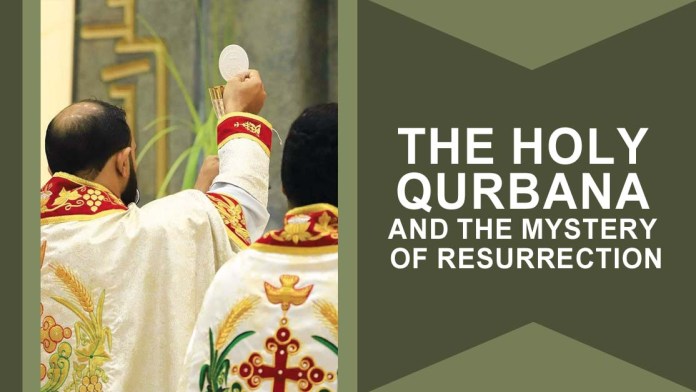
According to the Christian faith, the most important feast of the liturgical year is the Feast of the Resurrection. It is also known as the “Feast of Feasts,” the “Celebration of Celebrations,” and the “Great Sunday” (CCC 1169). The unity of God the Father’s plan of salvation is fulfilled in Christ’s Resurrection. Today, the Church remembers, observes, and celebrates this mystery of the Resurrection through the Holy Qurbana.
Even in the introductory rites of the Holy Qurbana, we recall and celebrate the mystery of the Resurrection in the Hymn of Resurrection, Lakumara (Lord of All). This hymn leads the people of God into the experience of the mystery of the Resurrection. The faithful bow before the altar, which symbolizes Christ’s tomb, during the singing of the Resurrection Hymn as a sign of adoration of the Risen Christ. During the exchange of peace in the Holy Qurbana, the faithful share the peace of the Risen Christ with one another. The Qurbana allows the worshiping community to proclaim the Risen Christ, participate in the celebration of the mystery of the Resurrection, and have a foretaste of communion with the Risen Lord.
The Mystery of the Resurrection and its Salvific Value
As proclaimed by St. Paul, “If Christ has not been raised, our preaching is useless and so is your faith” (1 Cor. 15:14). Christ’s Resurrection is the fulfillment of the Old Testament prophecies and the promises He made during His earthly life (CCC 652). The Nicene Creed affirms this by stating that Christ’s Resurrection fulfills the prophecies, as it is written (CCC 652). The Resurrection of the Crucified One reveals that He is truly the Son of God and God Himself (CCC 653). The salvific work accomplished through Christ and its eternal effects are experienced today in the Holy Qurbana.
The Paschal Mystery of Christ has two essential aspects: through His death, He freed us from sin, and through His Resurrection, He opened the way for us to a new life (CCC 654). These great dimensions of the Paschal Mystery are fully experienced by the faithful today through the Holy Qurbana. We can proclaim the Risen Christ, participate in His Resurrection, and experience in advance our own resurrection.
The Holy Qurbana: Proclaiming the Risen Christ
The Church offers the Holy Qurbana today in the same manner as Christ celebrated the Passover meal with His disciples. On the road to Emmaus, the Risen Jesus walked with His disciples, explained the Scriptures to them, and, while dining with them, took bread, blessed it, broke it, and gave it to them (Luke 24:13-35). The same Risen Christ, who explained the Scriptures and broke bread with His disciples, invisibly presides at every Eucharistic celebration. The bishop or priest, as the representative of Christ, presides over the liturgical gathering, delivers the homily after the reading of the Word, receives the offerings, and recites the Eucharistic prayers (CCC 1348). Thus, through the Risen Christ, the Church offers thanksgiving to God the Father in the Holy Spirit for creation, redemption, and sanctification (CCC 1352).
At the Conclusion of the Anaphora, in the epiclesis prayer, the Church prays to God the Father to send the Holy Spirit upon the bread and wine, transforming them into the Body and Blood of Christ. By partaking in them, the faithful become one body and spirit in Christ (CCC 1353). In the anamnesis prayer, the Church remembers and proclaims Christ’s Passion, Death, Resurrection, and glorious Second Coming, thereby celebrating the Risen Christ.
The Holy Qurbana: Participation in the Resurrection of Christ
The Risen Christ, seated at the right hand of God the Father, continually pours out the Holy Spirit upon His Church, His Mystical Body, and bestows His grace through the sacraments He instituted (CCC 1084). He is present in the Church’s liturgical celebrations to bestow the fruits of salvation (CCC 1083).
Through the offering of bread and wine in the Holy Qurbana, our lives are also sanctified and consecrated. “When He was at the table with them, He took bread, blessed it, broke it, and gave it to them. Then their eyes were opened, and they recognized Him” (Luke 24:30-31). The disciples received faith in Christ’s Resurrection through the grace of God by directly encountering the Risen Christ.
In the three Anapharas (Qudassas) of the Syro-Malabar liturgy, the fourth Gehantha (Prayer of Inclination), the Church gives thanks and prays in remembrance of the Paschal Mystery, which was fulfilled through the Risen Christ. In the Qurbana, we proclaim the mystery of the Resurrection, which renews and glorifies human nature. We profess that we are made worthy to enter into the glory of the Risen Christ. Through the epiclesis prayer, the bread and wine are transformed into the Body and Blood of the Risen Christ. By partaking in these divine mysteries, the faithful receive the remission of their sins and are made worthy of a renewed life.
Through the Holy Qurbana, we are able to proclaim the Risen Christ, live in His experience, and have a foretaste of future glory.
Rev. Dr. Rejoy Pazhayattil
