



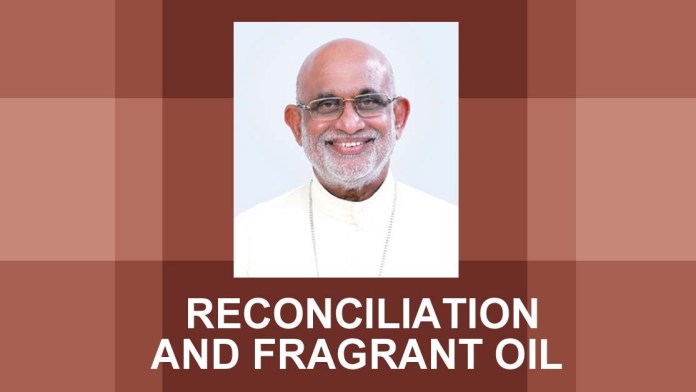
The Holy Scripture is a book that narrates the deeply emotional story of the relationship between God and humankind. The beginning of reconciliation lies in God seeking out humanity. In Genesis chapter 3, we read that the first parents fell into sin due to the temptation of the devil and were expelled from paradise. Genesis 3:10 presents the story of a God searching for the sinful human: “Adam, where are you?”
Rather than saying that reconciliation is about humans seeking God, the Bible tells the story of a God who is distressed, saddened, and deeply troubled by the loss of humanity. The most beautiful parables of reconciliation can be found in Luke chapter 15. In this chapter, Jesus teaches three parables, each illustrating different aspects of reconciliation.
One of these parables is the story of the lost coin. A woman with ten silver coins loses one. She becomes greatly distressed because it is a key coin, one that gives value to the other nine. This coin symbolizes the soul’s relationship with God. The way she searches for the coin gives us a great perspective—she does not search outside but inside her home. Reconciliation is about cleansing ourselves. We must light a lamp, pick up a broom, and diligently sweep. The lesson of reconciliation must begin with our hard work, perseverance, and a good heart.
The second parable in Luke 15 is the story of the lost sheep. Verses 4 to 7 are particularly meaningful as they highlight the stance of reconciliation. Out of a hundred sheep, only one goes missing. Ninety-nine remain. However, the shepherd knows the lost one is valuable. That is why he leaves the ninety-nine to go the extra mile in search of the missing one.
Some might say, “What is lost is lost. Let’s be content with what remains.” But the shepherd does not take that stance. He leaves the ninety-nine behind and seeks the one that is missing. When he finds the sheep entangled in thorns, his joy is indescribable. He bandages its wounds, carries it on his shoulders, and returns to the fold. One of the most beautiful images of Jesus is that of a shepherd joyfully carrying a sheep on his shoulders. Some Bible scholars believe this is the most beautiful parable Jesus taught. It shows the shepherd’s immense generosity in reconciliation and the boundless joy and kindness he experiences upon the return of the lost one.
Another remarkable parable in the Gospel is the story of the prodigal son. After the parables of the lost coin and the lost sheep, Luke tells this story, which is the very heartbeat of this chapter. The younger son perceives life with his father as a form of bondage. The Bible does not record the father advising the son, but we can assume it might have happened. The son demands his share of the inheritance and departs for a distant land. Bible scholars see a profound separation in the phrase “distant land.” Sin is always a separation—a separation from God, from parents, from siblings.
The son squanders all his inheritance. Sin is the destruction of God’s grace. Losing the wisdom, beauty, health, and talents given by God is what sin entails. When a severe famine strikes the land, he is affected as well. Even though he lives in extreme hardship, he does not initially think of returning to his father. Only in his lowest moment does he gain true understanding. The phrase “he came to his senses” signifies the intervention of the Holy Spirit.
Without the Holy Spirit’s intervention, true repentance cannot happen. Reconciliation and repentance are divine gifts facilitated by the Holy Spirit. As a result of this grace, the son returns to his father’s house. The father welcomes him at the door. The son does not sneak in through the back; he approaches from the front. He was afraid, yet the father ran to embrace him and led him back home. Our courage to return to the Father’s house is essential for reconciliation.
Reconciliation is complete when we unite with God. However, its growth depends on the bonds of humility we maintain with everyone around us—our parents, siblings, neighbors, priests, religious leaders, and those to whom we are indebted. Luke’s Gospel describes how Mary anointed the feet of Jesus with costly nard oil, filling the house with fragrance. She shattered the bottle of pride. When the bottle of pride is broken, it spreads fragrance within the home. Reconciliation is the breaking open of a bottle of perfume.
Just as Mary wept at Jesus’ feet in repentance, let us also reflect on our sins, strive to strengthen our relationships with others, and make this Lenten season meaningful. Let us pray for this grace. We have a God who waits for the lost to be found. May this deep realization free us from despair and help us move forward with hope.
Major Archbishop Mar Raphael Thattil
