



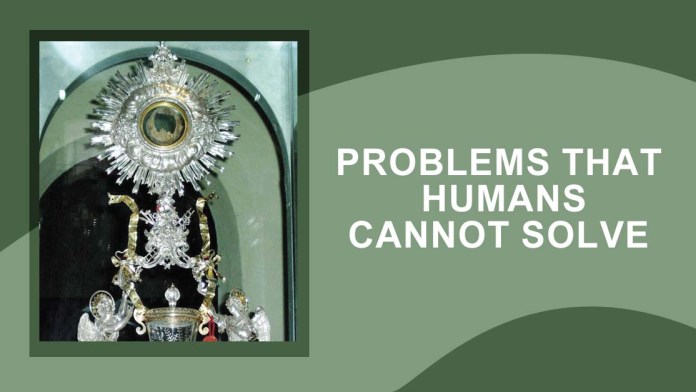
For some time, the priest had been deeply troubled by a crisis of faith. Even on that particular day, as he was celebrating the Holy Qurbana, the struggle within him remained intense. How could it be true that when an unworthy and sinful priest pronounces the words of consecration over bread and wine, they are transformed into the Body and Blood of Jesus Christ? How practical or believable could such a claim be? Filled with these inner doubts, he recited the words of consecration: “Take this, all of you, and eat of it,for this is my Body…for this is my blood..,which will be given up for you.” In that very moment, it happened. The priest could not believe his eyes. The Host in his hands had transformed into human flesh, and the wine into actual blood.
This miracle took place at the Monastery of St. Longinus in Lanciano, Italy. It occurred when a Brazilian monk was celebrating the Holy Qurbana, and it is considered the first recorded Eucharistic miracle in the history of the Catholic Church. The sacred relics of this miracle are preserved there to this day. The event is dated to the eighth century.
Another Eucharistic miracle, perhaps even more significant, occurred in Santarém, Portugal. This event is regarded as one of the most important in the history of Eucharistic miracles. A woman, seeking to bring her unbelieving and immoral husband back to the right path, approached a sorcerer for help. The man demanded that she bring him a consecrated Host as the means to fulfill her request. Accordingly, she went to St. Stephen’s Church and, during Holy Qurbana, received the Eucharist on her tongue. She immediately removed it and wrapped it in a cloth she had with her, then left the church. Upon returning home, she unwrapped the cloth to find it soaked in blood—the Host was bleeding.
Terrified, the woman returned to the church, confessed everything, and repented. The Host was then carried in procession back to the church.
Any miracle connected to the Holy Eucharist is referred to as a Eucharistic miracle. The transformation of consecrated bread and wine into real flesh and blood is regarded as a supernatural manifestation of the Divine Presence. Each of these Eucharistic miracles proclaims to the world the real presence of Christ in the Eucharist. These are events beyond human explanation and scientific reasoning. While numerous such miracles have taken place around the world, only about a hundred have received official recognition from the Church. Among them, the eighth-century miracle in Lanciano, Italy, and the thirteenth-century event in Portugal are considered extremely rare.
It is also important to understand that some Eucharistic miracles occurred in the context of historical crises. The miracle generally accepted as the first, in Lanciano, took place during the reign of Byzantine Emperor Leo III (717–741), who issued harsh decrees against Christianity. He destroyed holy images and persecuted clergy. Many Brazilian monks fled to Italy seeking refuge. It was in such a context that the first Eucharistic miracle occurred.
The Catholic Church differentiates between changes that occur due to natural causes and actual miracles in a rational manner when defining phenomena related to the Eucharist. For instance, an event in the Diocese of Dallas that was initially considered a miracle was later explained by biology professors at Dallas University. They concluded that the color change of the Host placed in a glass of water was due to a combination of fungal mycelium and bacterial colonies. However, this was not the case for the 2008 miracle in Sokolka. According to Professor Stanislaw Sulkowski of Bialystok Medical University, tissue fragments from the heart of a person who had suffered trauma were found on the Host believed to have undergone the miracle.
This must be viewed in connection with the Eucharistic miracle that took place on August 18, 1996, in Buenos Aires. As is usually done in such situations, Fr. Alejandro Pezet immediately placed the Sacred Host in water and preserved it in a small tabernacle. When he looked at it days later—on August 26—the Host had transformed into a substance that appeared bloody and fleshy. The investigations related to this incident were carried out under the leadership of Archbishop Jorge Bergoglio, who later became Pope Francis. The pathologist who examined the sample, Dr. Frederic, stated that the piece of flesh was from the myocardium of the left ventricle of the heart of a person who had undergone extreme pain. The blood found on it belonged to the human blood group AB.
Studies conducted on the Holy Shroud of Turin also confirmed that the blood stains on it are of AB group. The same result has been confirmed consistently in all the scientific studies carried out on the Sacred Hosts from various Eucharistic miracles across the world. From the first recorded Eucharistic miracle to the one that happened in Buenos Aires, this research finding has been repeatedly affirmed. In other words, Eucharistic miracles with the same nature have occurred both in the 8th century and in the 20th century.
A Eucharistic miracle is beyond human understanding and explanation. Therefore, the only response from a sinful and imperfect human being should be to bow in reverence and join hands in adoration. Every miracle should help strengthen our faith. To understand this mysterious secret revealed not to the wise but to infants, we need a heart as vast as the ocean-like the heart of Jesus who became as small as a grain of wheat. Let us pray for such a heart. And let us continuously proclaim praise, worship, and glory to the Most Holy and Divine Eucharist.
Vinayak Nirmal
Extraordinary Eucharistic signs in kerala
At St. Sebastian’s Church in Madavana, a girl named Agnes experienced a Eucharistic miracle when the Host turned into flesh as she received the Eucharist. This miracle occurred on three consecutive Sundays. The miraculous Host was later transferred to the diocesan center for detailed study.
Before this, a similar miracle occurred in Kanjikode, Palakkad, to a housewife named Rani John. On October 26, 1997, at the Good Shepherd Church in Kanjikode, during a Holy Qurbana offered by Bishop Mar Jacob Manathodath, the Host turned into the Body and Blood of Christ when she received the Eucharist. This miracle also repeated later. Many people witnessed both these miracles.
